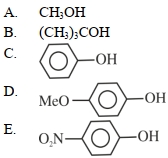
MCQ
Which of the following does not show mutarotation
- AMaltose
- ✓Sucrose
- CMannose
- DFructose
Maltose is a reducing sugar because it has a hydroxyl group on the right-hand ring (like the orientation of simple carbohydrates as beta or alpha).
Sucrose is not a reducing sugar because it does not have an available hydroxyl group. The glycosidic bond that forms in sucrose occurs between the anomeric carbons on glucose and fructose which eliminates the availability of the hydroxyl group. The anomeric carbon is the carbon where the ring forms between the hydroxyl carbon and the carbonyl carbon.
Without this hydroxyl group, the ring cannot open and close and therefore not undergo mutarotation. Reducing sugars can undergo mutarotation. Nonreducing sugars cannot undergo mutarotation.
Generate a complete, print-ready paper with questions like this in minutes — across 16+ boards, with answer keys.
$2NO + 2H_2 \longrightarrow N_2 + 2H_2O$
has following mechanism
Step $-I$ : $2NO \longrightarrow N_2O_2$
Step $-II$ : $N_2O_2 + H_2 \longrightarrow N_2O + H_2O$
Step $-III$ : $N_2O + H_2 \longrightarrow N_2 + H_2O$
Which of the following substance is a reaction intermediate
(image)
($1$) The compound $R$ is
(image)
($2$) The compound $T$ is
($A$) glycine
($B$) alanine
($C$) valine
($D$) serine
Given the answer question ($1$) and ($2$) 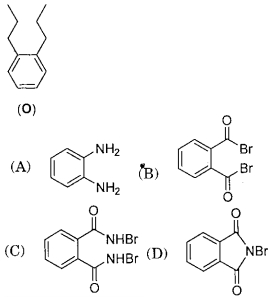
$\left[\mathrm{CoCl}\left(\mathrm{NH}_3\right)_5\right]^{2+}, \quad\left[\mathrm{Co}(\mathrm{CN})_6\right]^{3-} \text {, }$
$(A)$ $(B)$
$\left[\mathrm{Co}\left(\mathrm{NH}_3\right)_5\left(\mathrm{H}_2 \mathrm{O}\right)\right]^{3+}, \quad\left[\mathrm{Cu}\left(\mathrm{H}_2 \mathrm{O}\right)_4\right]^{2+}$
$(C)$ $(D)$
The correct order of $A$, $B$, $C$ and $D$ in terms of wavenumber of light absorbed is :
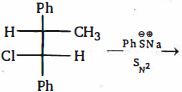

Choose the correct answer from the options given below: