MCQ
Which of the following does not uses formaldehyde in its preparation?
  • A
    Melamine polymer
  • B
    Bakelite
  • $\text{PHBV}$
  • D
    Preservation of biological specimens.

Answer

Correct option: C.
$\text{PHBV}$
Formaldehyde is not used in the preparation of $\text{PHBV. PHBV}$ is a thermoplastic polymer. The monomers$, 3-$hydroxybutanoic acid and $3-$hydroxypentanoic acid, are joined by ester bonds; the back bone of the polymer is made up of carbon and oxygen atoms.

Need a full question paper?

Generate a complete, print-ready paper with questions like this in minutes — across 16+ boards, with answer keys.

Start Generating Free

Similar questions

Which one of the following ionic species will impart colour to an aqueous solution?
Given :

$E^o_{Cr^{3+}/Cr} =-0.74\, V,\,$ $E^o_{MnO_4^-/Mn^{2+}} =1.51 \,V$

$E^o_{Cr_2O_7^{2-}/Cr^3+} =1.33\,V:$ $E^o_{Cl/Cl^-} =1.36\,V$

Based on the data given above, strongest oxidising agent will be :

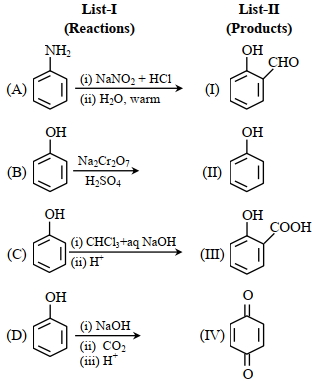
Match List-$I$ with List-$II$.

Choose the correct answer from the options given below:
An aqueous solution of an halogen salt of potassium reacts with same halogen $X_2$ to give $KX_3,$ a browncoloured solution, in which halogen exists as $X_3^-$ ion, $X_2$ as a Lewis acid and $X^-$ as a Lewis base, halogen $X$ is
$\begin{matrix}
   Ph-CH-OH  \\
   |\,\,\,\,\,\,  \\
   \,\,C{{H}_{3}}  \\
\end{matrix}$$\xrightarrow{{PCC}}A\xrightarrow[{(ii)\,\,{H^ \oplus }/\,\Delta }]{{(i)\,\,N{H_2}OH}}B + C$

In the given reaction sequence $B$ and $C$ are :

At $40\,^o C$, the vapour pressure (in torr) of methyl alcohol $(A)$ and ethyl alcohol $(B)$ solution is represented by :
$P_s = 120 X_A + 138$ ; where $X_A$ is mole fraction of methyl alcohol. The value of

$\mathop {\lim }\limits_{{X_A} \to 0} \left ( \frac{P_B^0}{X_B} \right )$ and $\mathop {\lim }\limits_{{X_B} \to 0}\left ( \frac{P_A^0}{X_A} \right )$ are

The dipole moments of halo compounds are in the order
When acetaldehyde is heated with Fehling solution, it gives a red precipitate of 
The major role of minor elements inside living organisms is to act as:
Industrially, ammonia is obtained by direct combination between nitrogen and hydrogen. The formation of ammonia is promoted at: