MCQ
Which of the following doesn't represent rotatory motion?
  • A


  • B


  • C


  • D
    Both A and C

Answer

  1. Both A and C

Explanation:

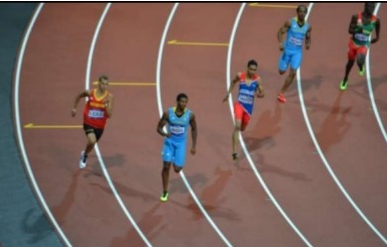
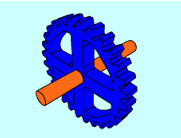
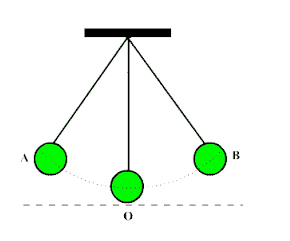
In picture A, the running people are exhibiting translational motion. In picture B, the wheel rotates about a fixed axis and thus it exhibits rotatory motion whereas in picture C, the bob of pendulum oscillates to and fro about its mean position and thus it exhibits oscillatory motion.

Need a full question paper?

Generate a complete, print-ready paper with questions like this in minutes — across 16+ boards, with answer keys.

Start Generating Free

Similar questions

Three particles of equal mass $m$ are situated at the vertices of an equilateral triangle of side $l$. They are moving in a circle in influence of their mutual gravitational interaction. Then their time period of revolution is directly proportional to
In order to double the frequency of the fundamental note emitted by a stretched string, the length is reduced to $\frac{3}{4}$$^{th}$ of the original length and the tension is changed. The factor by which the tension is to be changed, is
A particle of mass $m$ is moving in a circular path of constant radius $r$ such that its centripetal acceleration ${a_c}$ is varying with time t as, ${a_c} = {k^2}r{t^2}$, The power delivered to the particle by the forces acting on it is
A satellite with kinetic energy ${E_k}$ is revolving round the earth in a circular orbit. How much more kinetic energy should be given to it so that it may just escape into outer space
The distance travelled by a particle is directly proportional to $t^{1/2}$, where $t =$ time elapsed. What is the nature of motion ?
$A$ small object is attached to a light string which passes through a hollow tube. The tube is held by one hand and the string by the other. The object is stet into rotation in a circle of radius $r_1$. The string is then pulled down, shortening the radius of the circle to $r_2$. The ratio of the new kinetic energy to original kinetic energy is
If a body $A$ of mass $M$ is thrown with velocity $v$ at an angle of ${30^o}$ to the horizontal and another body $B$ of the same mass is thrown with the same speed at an angle of ${60^o}$ to the horizontal. The ratio of horizontal range of $A$ to $B$ will be
If we use permittivity $ \varepsilon $, resistance $R$, gravitational constant $G$ and voltage $V$ as fundamental physical quantities, then
From the top of a tower of height $40\,m$, a ball is projected upwards with a speed of $20\,m / s$ at an angle of elevation of $30^{\circ}$. The ratio of the total time taken by the ball to hit the ground to its time of flight (time taken to come back to the same elevation) is (take $g=10\,m / s ^2$ )
On a long horizontally moving belt, a child runs to and fro with a speed $9\, km\, h^{-1}$ (with respect to the belt) between his father and mother located $50\, m$ apart on the moving belt. The belt moves with a speed of $4\, km\, h^{-1}$. For an observer on a stationary platform, the speed of the child running in the direction of motion of the belt is ..... $km\,h^{-1}$