MCQ
Which of the following electronic configurations is not possible
  • A
    $1{s^2}\,\,2{s^2}$
  • B
    $1{s^2}2{s^2}2{p^6}$
  • C
    $3{d^{10}}4{s^2}4{p^2}$
  • $1{s^2}2{s^2}\,2{p^2}3{s^1}$

Answer

Correct option: D.
$1{s^2}2{s^2}\,2{p^2}3{s^1}$
d
(d) When $2p$  orbital is completely filled then electron enter in the $3s$. The capacity of $2p$  orbital containing ${e^ - }$is $6$. So $1{s^2},\,2{s^2}2{p^2}3{s^1}$ is a wrong electronic configuration the write is $1{s^2}2{s^2}2{p^3}.$

Need a full question paper?

Generate a complete, print-ready paper with questions like this in minutes — across 16+ boards, with answer keys.

Start Generating Free

Similar questions

Five valence electrons of $P^{15}$ are labelled as $\mathop {\boxed{AB}}\limits_{3s} \,\mathop {\boxed{X|Y|Z}}\limits_{3p} $ If the spin quantum numbers of $B$ and $Z$ is $ + \frac{1}{2}$ , the group of electron with three of the quantum number $(n, l, m)$ same are
Given below are two statement: one is labelled as Assertion $A$ and the other is labelled as Reason $R$

Assertion $A:$ $5 f$ electrons can participate in bonding to a far greater extent than $4 f$ electrons

Reason $R:$ $5 f$ orbitals are not as buried as $4 f$ orbitals

In the light of the above statements, choose the correct answer from the options given below

Inorganic graphite is:
$4$ -Pentenoic acid when treated with $I_2$ and $NaHCO_3$ gives
Addition of alcohols to aldehydes in presence of anhydrous acids yield
Number of molecules/species from the following having one unparred electron $15$. . . . . .  $\mathrm{O}_2, \mathrm{O}_2^{-1}, \mathrm{NO}, \mathrm{CN}^{-1}, \mathrm{O}_2^{2-}$
A first order reaction has the rate constant, $k =4.6$ $\times 10^{-3} s ^{-1}$. The number of correct statement/s from the following is/are

Given : $\log 3=0.48$

$A.$ Reaction completes in $1000\,s$.

$B.$ The reaction has a half-life of $500\, s$.

$C.$ The time required for $10\, \%$ completion is 25 times the time required for $90 \,\%$ completion.

$D.$ The degree of dissociation is equal to $\left(1-e^{-k t}\right)$.

$E.$ The rate and the rate constant have the same unit.
$10\ g$ of hydrogen and $64\ g$ of oxygen were filled in a steel vessel and exploded. Amount of water produced in this reaction will be ........... $\mathrm{mol}$
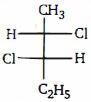
The configuration at $C-2$ and $C-3$ of the compound given
Which of the following ether is not produced by williamson ether synthesis