MCQ
Which of the following elements is found in native state
  • A
    $Al$
  • $Au$
  • C
    $Cu$
  • D
    $Na$

Answer

Correct option: B.
$Au$
b
(b) Gold is found in native state.

Need a full question paper?

Generate a complete, print-ready paper with questions like this in minutes — across 16+ boards, with answer keys.
Start Generating Free

Similar questions

Which of the following does not show any reducing test of aldehyde
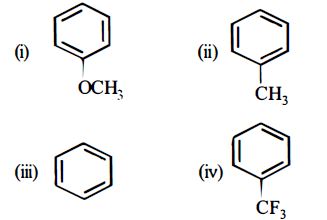
In the below mentioned compounds the decreasing order of reactivity towards electrophilic substitution is
Which of the following pairs is/are correctly matched?
  Reaction Product
$I$ $RX + AgCN$ $RNC$
$II$ $RX + KCN$ $RCN$
$III$ $RX + KNO_2$ (image)
$IV$ $RX + AgNO_2$ $R-O-N = O$

The reaction $Pb \left( NO _3\right)_2$ and $NaCl$ in water produces a precipitate that dissolves upon the addition of $HCl$ of appropriate concentration. The dissolution of the precipitate is due to the formation of
For which one of the following reactions, $\Delta H$ is not equal to $\Delta E$
The statement$(s)$ that are correct about the species $\mathrm{O}^{2-}, \mathrm{F}^{-}, \mathrm{Na}^{+}$and $\mathrm{Mg}^{2+}$.

$(A)$ All are isoelectronic

$(B)$ All have the same nuclear charge

$(C)$ $\mathrm{O}^{2-}$ has the largest ionic radii

$(D)$ $\mathrm{Mg}^{2+}$ has the smallest ionic radii

Choose the most appropriate answer from the options given below :

What current strength in amp. will be required to liberate $10\, g$ of chlorine from $NaCl$ solution in one hour ............. $\mathrm{amp}$
Match the compounds/ions in Column $I$ with their properties/reactions in Column $II$. Indicate your answer by darkening the appropriate bubbles of the $4 \times 4$ matrix given in the $ORS$.
Column $I$ Column $II$
$(A)$ $\mathrm{C}_6 \mathrm{H}_5 \mathrm{CHO}$ $(p)$ gives precipitate with $2, 4$-dinitrophenylhydrazine
$(B)$ $\mathrm{CH}_3 \mathrm{C} \equiv \mathrm{CH}$ $(q)$ gives precipitate with $\mathrm{AgNO}_3$
$(C)$ $\mathrm{CN}^{-}$ $(r)$ is a nucleophile
$(D)$ $\mathrm{I}^{-}$ $(s)$ is involved in cyanohydrin formation
$A$ is
Of the following which is diamagnetic in nature ?