MCQ
Which of the following formula is correct for a spherical lens?
  • A
    $\frac{1}{f}=\frac{1}{u}+\frac{1}{v}$
  • $\frac{1}{f}=\frac{1}{v}-\frac{1}{u}$
  • C
    $\frac{1}{u}=\frac{1}{v}-\frac{1}{f}$
  • D
    $f=\frac{u v}{u+v}$

Answer

Correct option: B.
$\frac{1}{f}=\frac{1}{v}-\frac{1}{u}$
(B) - $\frac{1}{f}=\frac{1}{v}-\frac{1}{u}$

Need a full question paper?

Generate a complete, print-ready paper with questions like this in minutes — across 16+ boards, with answer keys.
Start Generating Free

Similar questions

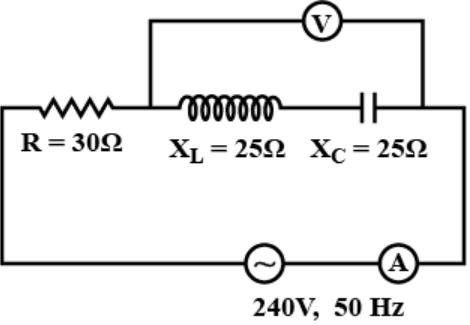
In the circuit shown in the figure, $($neglecting source resistance$)$ the voltmeter and ammeter readings will respectively be.
Image
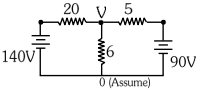
The value of current in the $6 \,\Omega$ resistance is $....\,A$
Two equal positive charges are kept at points $A$ and $B$. The electric potential at the points between $A$ and $B ($excluding these points$)$ is studied while moving from $A$ to $B$. The potential.
The Avogadro's number is $6\times 10^{23} $ per gm mole and electronic charge is $1.6\times 10^{-19}$ C . The Faraday's number is
If the dip circle is set at $45^o$ to the magnetic meridian, then the apparent dip is $30^o$. The true dip. of the place is
An electron enters between two horizontal plates separated by 2mm and having a potential difference of 1000V. The force on electron is 
The magnitude of saturation photoelectric current depends upon
You are given two lenses, a converging lens with focal length $+10\, cm$ and a diverging lens with focal length $- 20 \,cm$. Which of the following would produce a virtual image that is larger than the object?
Relative electrical conductivity and relative magnetic permeability of a substance is $\epsilon_r$ and $\mu_r$ What are the probable values of these quantities for any dimagnetic substance?
A current source sends a current $\text{I}-\text{i}_0\cos(\omega\text{t}).$ when connected across an unknown load, it gives a voltage output of $\text{v}=\text{v}_0\sin[\omega\text{t}+(\frac{\pi}{4})]$across that load. then the voltage across the current source may be brought in phase with the current through it by.