MCQ
Which of the following functions differentiable at $x = 0$ ?
  • A
    $cos (|x|)+|x|$
  • B
    $cos (|x|)-|x|$
  • C
    $sin (|x|)+|x|$
  • $sin (|x|)-|x|$

Answer

Correct option: D.
$sin (|x|)-|x|$
d
Let $f(x)=\sin (|x|)-|x|$

$\Rightarrow \quad f(x)=\left\{\begin{array}{ll}{\sin x-x:} & {x \geq 0} \\ {-\sin x+x ;} & {x<0}\end{array}\right.$

$\therefore \quad {f^\prime }\left( {{0^ + }} \right) = 0 = {f^\prime }\left( {{0^ - }} \right)$

$\Rightarrow \quad f(x)$ is differentiable at $x=0$

Need a full question paper?

Generate a complete, print-ready paper with questions like this in minutes — across 16+ boards, with answer keys.
Start Generating Free

Similar questions

The number of common tangents to the circles ${x^2} + {y^2} = 1$and ${x^2} + {y^2} - 4x + 3 = 0$ is
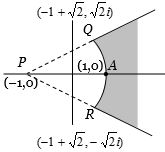
$PQ$ and $PR$ are two infinite rays. $QAR$ is an arc. Point lying in the shaded region excluding the boundary satisfies
The mean and the median of the following ten numbers in increasing order $10, 22, 26, 29, 34, x, 42, 67, 70, y$ are $42$ and $35$ respectively, then $\frac{y}{x}$ is equal to 
Let $O$ be the origin and $\overline{ OA }=2 \hat{ i }+2 \hat{ j }+\hat{ k }, \overline{ OB }=\hat{ i }-2 \hat{ j }+2 \hat{ k }$ and $\overline{ OC }=\frac{1}{2}(\overline{ OB }-\lambda \overline{ OA })$ for some $\lambda>0$. If $|\overline{ OB } \times \overline{ OC }|=\frac{9}{2}$, then which of the following statements is (are) TRUE?

$(A)$ Projection of $\overline{ OC }$ on $\overline{ OA }$ is $-\frac{3}{2}$

$(B)$ Area of the triangle $OAB$ is $\frac{9}{2}$

$(C)$ Area of the triangle $ABC$ is $\frac{9}{2}$

$(D)$ The acute angle between the diagonals of the parallelogram with adjacent sides $\overline{ OA }$ and $\overline{ OC }$ is $\frac{\pi}{3}$

$Let g (x)$  be the inverse of an invertible function $f(x)$ which is differentiable at  $x = c, $ then $g'(f(c))$ equals
$i \times (j \times k) = $
$\int_0^a {{x^2}\sin {x^3}\,dx} $ equals
Let the system of equations
$x+5 y-z=1$
$4 \mathrm{x}+3 \mathrm{y}-3 \mathrm{z}=7$
$24 x+y+\lambda z=\mu$
$\lambda, \mu \in R$, have infinitely many solutions. Then the number of the solutions of this system,
If $\mathrm{x}, \mathrm{y}, \mathrm{z}$ are integers and satisfy $7 \leq \mathrm{x}+\mathrm{y}+\mathrm{z} \leq 77$, is
The diagonals of the parallelogram whose sides are $lx + my + n = 0,$ $lx + my + n' = 0$,$mx + ly + n = 0$, $mx + ly + n' = 0$ include an angle
If the equation $\frac{1}{x} + \frac{1}{{x - 1}} + \frac{1}{{x - 2}} = 3{x^3}$ has $k$ real roots, then $k$ is equal to -