Question
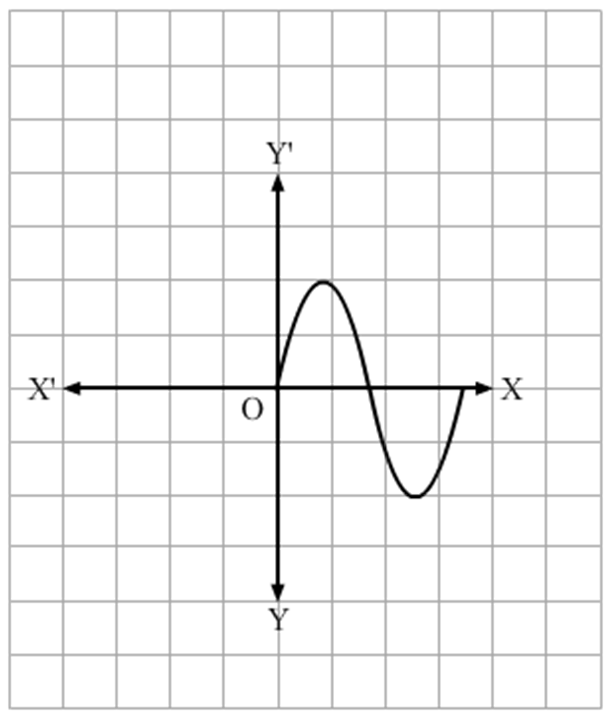
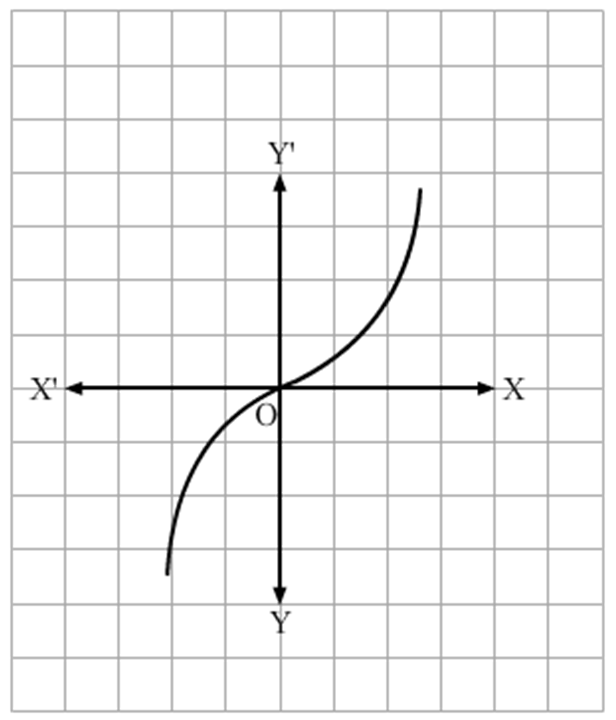
Which of the following graphs represents a one-one function?
  1.  
  1.  

Answer

In the graph of (b), different elements on the x-axis have different images on the y-axis. But in (a), the graph cuts the x-axis at 3 points, which means that 3 points on the x-axis have the same image as O and hence, it is not one-one.

Need a full question paper?

Generate a complete, print-ready paper with questions like this in minutes — across 16+ boards, with answer keys.
Start Generating Free

Similar questions

Determine whether or not the definition of $^*$ given below gives a binary operation. In the event that $^*$ is not a binary operation give justification of this. On $R,$ define by $a ^* b = ab^2.$
Here, $Z^+$ denotes the set of all non$-$negative integers.
If $A=\left[\begin{array}{cc} {\sin \alpha} & {\cos \alpha} \\ {-\cos \alpha} & {\sin \alpha} \end{array}\right]$, then verify that A′ A = I
A bag contains 8 marbles of which 3 are blue and 5 are red. One marble is drawn at random, its cooler is noted and the marble is replaced in the bag. A marble is again drawn from the bag and its colour is noted. Find the probability that the marble will be,
Of the same colour.
If $\vec{\text{a}},\vec{\text{b}},\vec{\text{c}}$ represent the sides of a triangle taken in order, then write the value of $\vec{\text{a}}+\vec{\text{b}}+\vec{\text{c}}$.
Find:
$\int \frac{\text{dx}}{\sqrt{3 - \text{2x - x}^{2}}}$
Find the values of 'a' for which the vectors
$\vec{\text{a}}=\hat{\text{i}}+2\hat{\text{j}}+\hat{\text{k}},\vec\beta={\text{a}}\hat{\text{i}}+\hat{\text{j}}+2\hat{\text{k}}$ and $\vec\gamma=\hat{\text{i}}+2\hat{\text{j}}+\text{a}\hat{\text{k}}$ are coplanar.
Find the probability distribution of the number of sixes in three tosses of a die.
Use elementary column operation $C_2 \rightarrow C_2 + 2C_1$ in the following matrix equation $:\begin{pmatrix} 2 & 1 \\ 2 & 0 \end{pmatrix}=\begin{pmatrix} 3 & 1 \\ 2 & 0 \end{pmatrix}\begin{pmatrix} 1 & 0 \\ -1 & 1 \end{pmatrix}$
Let $A$ and $B$ be square matrices of the order $"3 \times 3", Is (AB)^2 = A^2B^2?$ Give reasons.
Differentiate the functions with respect to x.
$\sin(\text{ax + b})$