MCQ
Which of the following Grignard reagent can be prepared ?
  • A
    $Br - Mg -CH_2 - CH_2 - CH_2 - O -H$
  • B
    $Br-Mg - CH_2 - CH_2 -SH$
  • C
    $BrMg - CH_2 - CH_2 - NH_2$
  • $\begin{array}{*{20}{c}}
      {BrMg - C{H_2} - C{H_2} - N - C{H_3}} \\ 
      {{\mkern 1mu} {\mkern 1mu} {\mkern 1mu} {\mkern 1mu} {\mkern 1mu} {\mkern 1mu} {\mkern 1mu} {\mkern 1mu} {\mkern 1mu} {\mkern 1mu} {\mkern 1mu} {\mkern 1mu} {\mkern 1mu} {\mkern 1mu} {\mkern 1mu} {\mkern 1mu} {\mkern 1mu} {\mkern 1mu} {\mkern 1mu} {\mkern 1mu} {\mkern 1mu} {\mkern 1mu} {\mkern 1mu} {\mkern 1mu} {\mkern 1mu} {\mkern 1mu} {\mkern 1mu} {\mkern 1mu} \,\,\,\,\,{\mkern 1mu} \,\,\,\,\,\,\,\,\,\,\,\,\,\,\,\,\,\,\,\,\,\,\,\,\,\,\,\,\,\,\,\,\,\,\,\,\,{\mkern 1mu} {\mkern 1mu} {\mkern 1mu} |\,\,\,\,\,\,\,\,\,\,\,\,} \\ 
      {{\mkern 1mu} {\mkern 1mu} {\mkern 1mu} {\mkern 1mu} {\mkern 1mu} {\mkern 1mu} {\mkern 1mu} {\mkern 1mu} {\mkern 1mu} {\mkern 1mu} {\mkern 1mu} {\mkern 1mu} {\mkern 1mu} {\mkern 1mu} {\mkern 1mu} {\mkern 1mu} {\mkern 1mu} {\mkern 1mu} {\mkern 1mu} {\mkern 1mu} {\mkern 1mu} {\mkern 1mu} {\mkern 1mu} {\mkern 1mu} {\mkern 1mu} {\mkern 1mu} {\mkern 1mu} {\mkern 1mu} {\mkern 1mu} {\mkern 1mu} {\mkern 1mu} {\mkern 1mu} {\mkern 1mu} {\mkern 1mu} {\mkern 1mu} {\mkern 1mu} {\mkern 1mu} \,\,\,\,\,{\mkern 1mu} \,\,\,\,\,\,\,\,\,\,\,\,\,\,\,\,\,\,\,\,\,\,\,\,\,\,\,\,\,\,\,\,\,\,\,\,\,\,C{H_3}\,\,\,\,\,\,\,\,\,\,\,\,\,} 
    \end{array}$
Answer

Correct option: D.
$\begin{array}{*{20}{c}}
  {BrMg - C{H_2} - C{H_2} - N - C{H_3}} \\ 
  {{\mkern 1mu} {\mkern 1mu} {\mkern 1mu} {\mkern 1mu} {\mkern 1mu} {\mkern 1mu} {\mkern 1mu} {\mkern 1mu} {\mkern 1mu} {\mkern 1mu} {\mkern 1mu} {\mkern 1mu} {\mkern 1mu} {\mkern 1mu} {\mkern 1mu} {\mkern 1mu} {\mkern 1mu} {\mkern 1mu} {\mkern 1mu} {\mkern 1mu} {\mkern 1mu} {\mkern 1mu} {\mkern 1mu} {\mkern 1mu} {\mkern 1mu} {\mkern 1mu} {\mkern 1mu} {\mkern 1mu} \,\,\,\,\,{\mkern 1mu} \,\,\,\,\,\,\,\,\,\,\,\,\,\,\,\,\,\,\,\,\,\,\,\,\,\,\,\,\,\,\,\,\,\,\,\,\,{\mkern 1mu} {\mkern 1mu} {\mkern 1mu} |\,\,\,\,\,\,\,\,\,\,\,\,} \\ 
  {{\mkern 1mu} {\mkern 1mu} {\mkern 1mu} {\mkern 1mu} {\mkern 1mu} {\mkern 1mu} {\mkern 1mu} {\mkern 1mu} {\mkern 1mu} {\mkern 1mu} {\mkern 1mu} {\mkern 1mu} {\mkern 1mu} {\mkern 1mu} {\mkern 1mu} {\mkern 1mu} {\mkern 1mu} {\mkern 1mu} {\mkern 1mu} {\mkern 1mu} {\mkern 1mu} {\mkern 1mu} {\mkern 1mu} {\mkern 1mu} {\mkern 1mu} {\mkern 1mu} {\mkern 1mu} {\mkern 1mu} {\mkern 1mu} {\mkern 1mu} {\mkern 1mu} {\mkern 1mu} {\mkern 1mu} {\mkern 1mu} {\mkern 1mu} {\mkern 1mu} {\mkern 1mu} \,\,\,\,\,{\mkern 1mu} \,\,\,\,\,\,\,\,\,\,\,\,\,\,\,\,\,\,\,\,\,\,\,\,\,\,\,\,\,\,\,\,\,\,\,\,\,\,C{H_3}\,\,\,\,\,\,\,\,\,\,\,\,\,} 
\end{array}$
d
$(d)$ The Grignard reagent is a very powerful base ; in effect it contains a  carbanion. Thus, it is not possible to prepare a Grignard reagent from an  organic group that contains an acidic hydrogen ; by an acidic hydrogen, we  mean any hydrogen more acidic than the hydrogen atoms of an alkane or  alkene. We cannot, for example, prepare a Grignard reagent from a compound containing an $- OH$ group, an $- NH -$  group, an $- SH$ group, a $- CO_2H$ group, or an $- SO_3H$ group. If we were to attempt to prepare a  Grignard reagent from an organic halide containing any of these groups, the  formation of the Grignard reagent would simply fail to take place. (Even if a  Grignard reagent were to form, it would immediately react with the acidic  group.) 

Since Grignard reagents are powerful nucleophiles, we cannot prepare a  Grignard reagent from any organic halide that contains a carbonyl, epoxy, nitro,  or cyano $(- CN)$ group. If we were to attempt to carry out this kind of  reaction, any Grignard reagent that formed would only react with the unreacted  starting material 


This means that when we prepare Grignard reagents, we are effectively limited  to alkyl halides or to analogous organic halides containing carbon -  carbon double bonds, internal triple bonds, ether linkages, and -$NR_2$ groups 

Need a full question paper?

Generate a complete, print-ready paper with questions like this in minutes — across 16+ boards, with answer keys.

Start Generating Free

Similar questions

Assertion : If a liquid solute more volatile than the solvent is added to the solvent, the vapour pressure of the solution may increase i.e., $p_s > p^o$.

Reason : In the presence of a more volatile liquid solute, only the solute will form the vapours and solvent will not.

Number of products in the given reaction :

${C_6}{H_5}CHO + C{H_3} - CHO\xrightarrow{{\mathop O\limits^\Theta  H}}$ Product

will be

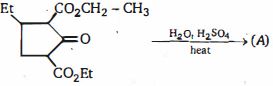
Product $(A)$ will be
If $EAN$ of central metal cation $M^{2+}$ in a non-chelating complex is $36$ and  atomic no. of metal $M$ is $26$, then the number of monodentate ligand in this  complex are 
The statement that is $INCORRECT$ about the interstitial compound is
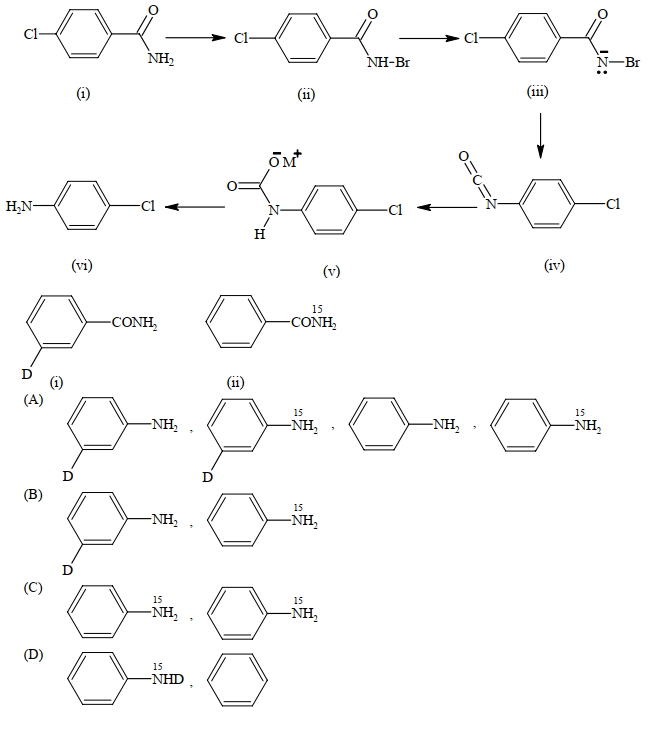
$\mathrm{RCONH}_2$ is converted into $\mathrm{RNH}_2$ by means of Hofmann bromamide degradation.

$Image$

In this reaction, $\mathrm{RCONHBr}$ is formed from which this reaction has derived its name. Electron donating group at phenyl activates the reaction. Hofmann degradation reaction is an intramolecular reaction.

$1.$  How can the conversion of $(i)$ to $(ii)$ be brought about?

$(A)$ $\mathrm{KBr}$  $(B)$ $\mathrm{KBr}+\mathrm{CH}_3 \mathrm{ONa}$  $(C)$ $\mathrm{KBr}+\mathrm{KOH}$  $(D)$ $\mathrm{Br}_2+\mathrm{KOH}$

$2.$  Which is the rate determining step in Hofmann bromamide degradation?

$(A)$ Formation of $(i)$  $(B)$ Formation of $(ii)$  $(C)$ Formation of $(iii)$  $(D)$ Formation of $(iv)$

$3.$  What are the constituent amines formed when the mixture of $(i)$ and $(ii)$ undergoes Hofmann bromamide degradation?

$Image$

give the answer question $1$, $2$, and $3.$

For a first order reaction $A \rightarrow B$, the rate constant, $k =5.5 \times 10^{-14} \,s ^{-1}$. The time required for $67\, \%$ completion of reaction is $x \,\times 10^{-1}$ times the half life of reaction. The value of $x$ is $....$ (Nearest integer)
The electrolytic conductance is a direct measure of
Reduction reactions of carbonyl compounds is known to be:
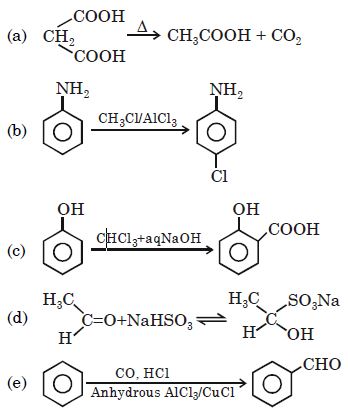
Which of the following reaction is incorrect