MCQ
Which of the following has a larger chromatic aberration?
  • A
    Crown$-$glass lens
  • Flint$-$glass lens
  • C
    Both have equal chromatic aberration
  • D
    Insufficient information

Answer

Correct option: B.
Flint$-$glass lens

Flint$-$glass lens has a larger chromatic aberration because the dispersive power of flint$-$glass is higher.

Need a full question paper?

Generate a complete, print-ready paper with questions like this in minutes — across 16+ boards, with answer keys.
Start Generating Free

Similar questions

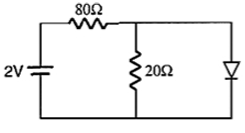
In the circuit shown, the current through the ideal diode is:
Image
The magnetic induction at the centre of a current carrying circular coil of radius $10\, cm$ is $5\sqrt 5 \,times$ the magnetic induction at a point on its axis. The distance of the point from the centre of the coil (in $cm$) is
A diver looking up through the water sees the outside world contained in a circular horizon. The refractive index of water is $\frac{4}{3}$,  and the diver's eyes are $15\, cm$ below the surface of water. Then the radius of the circle is
A semiconductor device is connected in a series circuit with a battery and a resistance. A current is found to pass through the circuit. If the polarity of the battery is reversed, the current drops almost to zero. The device may be
How many meters of a thin wire are required to design a solenoid of length $1m$ and $L = 1\ mH$? Assume cross$-$sectional diameter is very small.
In a coil of area $10\;c{m^2}$ and $10$ turns with a magnetic field directed perpendicular to the plane and is changing at the rate of ${10^8}$gauss/second. The resistance of the coil is $20\, ohm$. The current in the coil will be........$amp$
When one light ray is reflected from a plane mirror with $30^{\circ}$ angle of reflection, the angle of deviation of the ray after reflection is $.....^{\circ}$
In a laboratory four convex lenses ${L_1},\,{L_2},\,{L_3}$ and ${L_4}$ of focal lengths $2, 4, 6$ and $8 cm$ respectively are available. Two of these lenses form a telescope of length $10 cm$ and magnifying power $4.$ The objective and eye lenses are
Kirchoff’s first law, i.e., $S i = 0$ at a junction, deals with the conservation of:
The angular resolution of a $10 \;cm$ diameter telescope at a wavelength of $5000 \;\mathring A$ is of the order