MCQ
Which of the following has a linear structure
  • A
    $CC{l_4}$
  • ${C_2}{H_2}$
  • C
    $S{O_2}$
  • D
    ${C_2}{H_4}$

Answer

Correct option: B.
${C_2}{H_2}$
(b) There is $sp$ hybridization in ${C_2}{H_2}$ so it has the linear structure.

Need a full question paper?

Generate a complete, print-ready paper with questions like this in minutes — across 16+ boards, with answer keys.
Start Generating Free

Similar questions

A sample of gas is compressed from an initial volume of $2V_0$ to $V_0$ using three different processess.
First: Using reversible isothermal.
Second: Using reversible adiabatic
Third: Using irreversible adiabatic under a constant external pressure.
Than
When petroleum is heated the vapours contain mainly
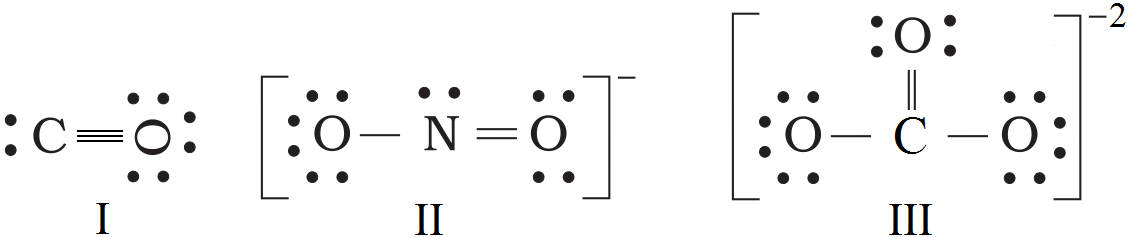
Lewis dot structure of CO2 $\text{NO}_2^-$ and $\text{CO}^{2-}_3$ are I, II and III respectively:

Which of the above structure(s) is/ are wrong?
Answer the following by appropriately matching the lists based on the information given in the paragraph Consider the Bohr's model of a one-electron atom where the electron moves around the nucleus. In the following $List-I$ contains some quantities for the $n^{t /}$ orbit of the atom and $List-II$ contains options showing how they depend on $n$.

Which of the following options has the correct combination considering $List-I$ and $List-II$?

$List-I$ $List-II$
$(I)$ Radius of the $n^{\text {th }}$ orbit $(P)$ $\propto n ^{-2}$
$(II)$ Angular momentum of the electron in the $n^{\text {th }}$ orbit $(Q)$ $\propto n ^{-1}$
$(III)$ Kinetic energy of the electron in the $n^{\text {th }}$ orbit $(R)$ $\propto n ^0$
$(IV)$ Potential energy of the electron in the $n^{\text {th }}$ orbit $(S)$ $\propto n ^1$
  $(T)$ $\propto n ^2$
  $(U)$ $\propto n ^{1 / 2}$

($1$) Which of the following options has the correct combination considering $List-I$ and $List-II$?

$(1) (II), (R)$ $(2) (I), (P)$ $(3) (I), (T)$ $(4) (II), (Q)$

($2$) Which of the following options has the correct combination considering $List-I$ and $List-II$?

$(1) (III), (S)$ $(2) (IV), (Q)$ $(3) (IV),(U)$ $(4) (III), (P)$

Give the answer or quetion ($1$) and ($2$)
In which of the following species the bonds are non-directional?
Which of the following has the least ionization potential
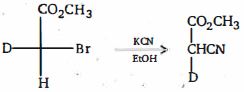
The configurations of the reactant and the product in the following reaction,  respectively, are:
A measured temperature on Fahrenheit scale is 200°F. What will this reading be on Celsius scale?
Boiling point of alkanes are:
Principal quantum number of an atom represents