MCQ
Which of the following has highest boiling point
- A$N{H_3}$
- B$P{H_3}$
- C$As{H_3}$
- ✓$Sb{H_3}$
| $N{H_3}$ | $P{H_3}$ | $As{H_3}$ | $Sb{H_3}$ | |
| B.pt in ($K$) | $238.5$ | $185.5$ | $210.6$ | $ 254.6$ |
Generate a complete, print-ready paper with questions like this in minutes — across 16+ boards, with answer keys.
Reason : Oxygen forms $p\pi \,-\, p\pi $ multiple bond due to small size and small bond length but $p\pi \,-\,p\pi $ bonding is not possible in sulphur.
In the above first order reaction the initial concentration of $\mathrm{N}_{2} \mathrm{O}_{5}$ is $2.40 \times 10^{-2}\, \mathrm{~mol} \,\mathrm{~L}^{-1}$ at $318 \,K.$ The concentration of $\mathrm{N}_{2} \mathrm{O}_{5}$ after $1\, hour$ was $1.60 \times 10^{-2}\, \mathrm{~mol} \,\mathrm{~L}^{-1}$, The rate constant of the reaction at $318\, \mathrm{~K}$ is $.....\,\times 10^{-3} \mathrm{~min}^{-1}$. (Nearest integer)
[Given: $\log 3=0.477, \log 5=0.699$ ]
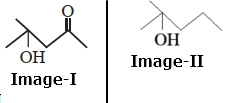
Assertion $A$ : $Image-I$ can be easily reduced using $Zn - Hg / HCl$ to $Image-II$
Reason $R : Zn - Hg / HCl$ is used to reduce carbonyl group to $- CH _2-$ group.
In the light of the above statements, choose the correct answer from the options given below: