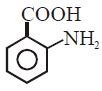
MCQ
Which of the following has maximum melting point
  • A


  • C

  • D

Answer

Correct option: B.

b

Need a full question paper?

Generate a complete, print-ready paper with questions like this in minutes — across 16+ boards, with answer keys.

Start Generating Free

Similar questions

Solid $CuSO_4·5H_2O$ having covalent, ionic as well as co-ordinate bonds. Copper atom/ion forms ................. co-ordinate bonds with water.
$OCH - CHO\xrightarrow{{O{H^ - }}}HO{H_2}C - COOH$  The reaction given is
Resistance of a conductivity cell (cell constant $129 \;m ^{-1}$ ) filled with $74.5\; ppm$ solution of $KCl$ is $100\; \Omega$ (labelled as solution 1). When the same cell is filled with $KCl$ solution of $149 \;ppm$, the resistance is $50\; \Omega$ (labelled as solution 2). The ratio of molar conductivity of solution $1$ and solution $2$ is i.e. $\frac{\wedge_{1}}{\wedge_{2}}=x \times 10^{-3}$. The value of $x$ is

(Nearest integer)

Given, molar mass of $KCl$ is $74.5 g mol ^{-1}$

Given below are two statements

Statement $I :$ The $E ^{\circ}$ value of $Ce ^{4+} / Ce ^{3+}$ is $+1.74 \,V$

Statement $II :$ $Ce$ is more stable in $Ce ^{4+}$ state than $Ce ^{3+}$ state.

In the light of the above statements, choose the most appropriate answer from the options given below

Which of the following is the correct order of increasing field strength of ligands to form coordination compounds?
A gene is a segment of a molecule of
In the structure of $ClF_3$, the number of lone pairs of electrons on central atom $Cl$ is
Match List $I$ with List $II$

$1-$ Bromopropane is reacted with reagents in List $I$ to give product in List $II$

List$I-$  Reagent List$II-$Product
$A$ $KOH (\text { alc) }$ $I$ Nitrile
$B$ $KCN \text { (alc) }$ $II$ Ester
$C$ $AgNO _2$ $III$ Alkene
$D$ $H _3 CCOOAg$ $IV$ Nitroalkane
The solution $A$ and $B$ are $0.1$ and $0.2\,molar$ in a substance. If $100\,ml$ of $A$ are mixed with $25\,ml$ of $B$ and there is no change in volume, then the final molarity of solution is ......... $M$.
Which one of the following nitro-compounds does not react with nitrous acid ?