MCQ
Which of the following has smallest ionic radius ?
- ANd3+
- BDy3+
- CLu3+
- DPm3+
Explanation:
As we move from left to right in a raw, radii decreases.
So radii of Lu+3 is smallest among all.
Generate a complete, print-ready paper with questions like this in minutes — across 16+ boards, with answer keys.
$(I)\, [Ni(CN)_4]^{2-}\,\,\,(II)\, [NiCl_4]^{2-}\,\,\,(III)\,Ni(CO_4)\,\,\,$
$(IV)\, [Ni(H_2O)_6 ]^{2+}$
| $column 1$ | $column 2$ | $column 3$ |
| $(I)$ Toluene | $(i)$ $\mathrm{NaOH} / \mathrm{Br}_2$ | $(P)$ Condensation |
| $(II)$ Acetophenone | $(ii)$ $\mathrm{Br}_2 / \mathrm{h} v$ | $(Q)$ Carboxylation |
| $(III)$ Benzaldehyde | $(iii)$ $\left(\mathrm{CH}_3 \mathrm{CO}\right)_2 \mathrm{O} / \mathrm{CH}_3 \mathrm{COOK}$ | $(R)$ Substion |
| $(IV)$ Phenol | $(iv)$ $\mathrm{NaOH} / \mathrm{CO}_2$ | $(S)$ Haloform |
($1$) For the synthesis of benzoic acid, the only $CORRECT$ combination is
$[A] (III) (iv) (R)$ $[B] (IV)(ii) (P)$ $[C] (I) (iv) (Q)$ $[D] (II) (i) (S)$
($2$) The only CORRECT combination in which the reaction proceeds through radical mechanism is
$[A] (I)$ $(ii) (R)$ $[B] (II) (iii) (R)$ $[C] (III) (ii) (P)$ $[D] (IV) (i) (Q)$
($3$) The only CORRECT combination that gives two different carboxylic acids is
$[A] (IV) (iii) (Q)$ $[B] (III) (iii) (P)$ $[C] (II) (iv) (R)$ $[D] (I) (i) (S)$
Given the answer quetion ($1$) ($2$) and ($3$)
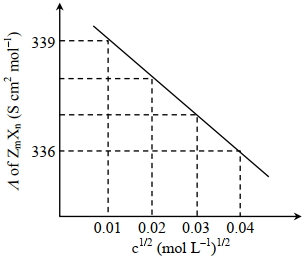
| $Ion$ | $Z ^{ n +}$ | $Z ^{ P +}$ | $Z ^{ n +}$ | $Z ^{ m +}$ | $Z ^{ m +}$ |
| $\lambda^0\left( S cm ^2 mol ^{-1}\right)$ | $50.0$ | $25.0$ | $100.0$ | $80.0$ | $100.0$ |
$\lambda^0$ is the limiting molar conductivity of ions
The plot of molar conductivity $(4)$ of $Z _{ m } X _{ n } v s c ^{1 / 2}$ is given below.