MCQ
Which of the following has zero valency
  • A
    Sodium
  • B
    Beryllium
  • C
    Aluminium
  • Krypton

Answer

Correct option: D.
Krypton
d
Noble Gases have zero valencies. Among the given options, only krypton is a noble gas.

Need a full question paper?

Generate a complete, print-ready paper with questions like this in minutes — across 16+ boards, with answer keys.

Start Generating Free

Similar questions

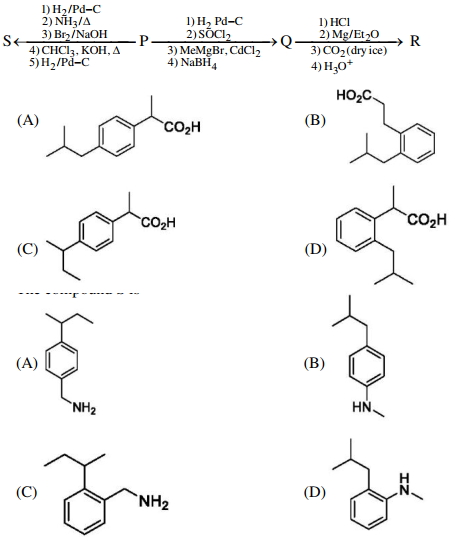
An organic acid $P \left( C _{11} H _{12} O _2\right)$ can easily be oxidized to a dibasic acid which reacts with ethyleneglycol to produce a polymer dacron. Upon ozonolysis, $P$ gives an aliphatic ketone as one of the products. $P$ undergoes the following reaction sequences to furnish $R$ via $Q$. The compound $P$ also undergoes another set of reactions to produce $S$.

(image)   

($1$) The compound $R$ is

(image) 

($2$) The compound $S$ is

(image) 

Give the answer or quetion ($1$) and ($2$)
Which of the following species has polar and non-polar bonds but molecule as a  whole is non-polar ?
A solution containing $30\,gms$ of non-volatile solute in exactly $90\,gm$ water has a vapour pressure of $21.85 \,\,mm\,Hg$ at ${25\,^o}C$. Further $18 \,gms$ of water is then added to the solution. The resulting solution has a vapour pressure of $ 22.15\,\,mm\,Hg$ at ${25\,^o}C$. Calculate the molecular weight of the solute
$n-$ heptane $\xrightarrow[{600\,{}^oC}]{{C{r_2}{O_3}/{V_2}{O_3}}}$ ?
Which of the following double salt does not exist ?
Product $(Q)$ in this reaction is
Ozonolysis of an organic compound $'A'$ produces acetone and propionaldehyde in equimolar mixture. Identify $A$ from the following compounds
For the reaction $2A + B \to C$,the values of initial rate at different reactant concentrations are given in the table below: The rate law for the reaction is

$[A] (mol\,L^{-1})$ $[B] (mol\,L^{-1})$ Initial Rate $(mol\, L^{-1}\,s^{-1} )$
$0.05$ $0.05$ $0.045$
$0.10$ $0.05$ $0.090$
$0.20$ $0.10$ $0.72$


The increasing order of reactivity of the following compounds towards reaction with alkyl halide directly is
If the CFSE of $\left[ Ti \left( H _2 O \right)_6\right]^{3+}$ is $-96.0\,kJ / mol$, this complex will absorb maximum at wavelength $........nm$. (nearest integer)

Assume Planck's constant $( h )=6.4 \times 10^{-34}\,Js$ Speed of light $( c )=3.0 \times 10^8\,m / s$ and Avogadro's constant $\left( N _{ A }\right)=6 \times 10^{23} / mol$