MCQ
Which of the following is coloured
  • A
    $ScC{l_3}$
  • B
    $Ti{O_2}$
  • $MnS{O_4}$
  • D
    $ZnS{O_4}$

Answer

Correct option: C.
$MnS{O_4}$
c
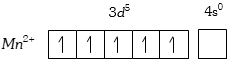
(c) $MnS{O_4}\, \to \,M{n^{2 + }} + SO_4^{2 - }$

due to presence of unpaired electrons it will form coloured salt.
Need a full question paper?

Generate a complete, print-ready paper with questions like this in minutes — across 16+ boards, with answer keys.

Start Generating Free

Similar questions

$200\, mL$ of an aqueous solution of a protein contains its $1.26\, g.$ The osmotic pressure of this solution at $300\, K$ is found to be $2.57 \times 10^{-3}$ bar. The molar mass of protein will be  .........$g\, mol^{-1}$

$(R = 0.083 \,L\, bar \,mol^{-1}\, K{-1})$

The species having bond order different from that in $CO$  is
${P_2}{O_5}$ is heated with water to give
Which enzyme converts glucose and fructose both into ethanol
The correct order of electron affinity of B, C, Ne, O is :
Observe the following four solutions :

$P : 10\ ml, 0.1\ M\ NaOH + 5\ ml, 0.1\ M\ HCl$

$Q : 10\ ml, 0.1\ M\ NaOH + 15\ ml, 0.1\ M\ CH_3COOH$

$R : 10\ ml, 0.1\ M\ NH_3 + 10\ ml, 0.1\ M\ NH_4Cl$

$S : 10\ ml, 0.05\ M\ NaF + 5\ ml, 0.1\ M\ HF$

Which of above solutions act as buffer

Because of lanthanoid contraction, which of the following pairs of elements have nearly same atomic radii ? (Numbers in the parenthesis are atomic numbers)
$\begin{matrix}
   C{{H}_{3}}-CH-C{{H}_{3}}  \\
   \,|\,\,\,\,\,\,\,\,\,  \\
   OH\,\,\,  \\
\end{matrix}$$\xrightarrow{PB{{r}_{3}}}A\xrightarrow{Mg}B\xrightarrow{\begin{matrix}
   O\,\,  \\
   /\,\,\,\,\backslash \,  \\
   C{{H}_{2}}-\,C{{H}_{2}}  \\
\end{matrix}}C$ $\xrightarrow{{{H_2}O}}D$ Here, $D$ is
A physician wishes to prepare a buffer solution at $pH = 3.58$ that efficiently resists changes in $pH$ yet contains only small concentration of the buffering agents. Which of the following weak acids together with its sodium salt would be best to use
Heats of combustion $(\Delta {H^o})$ for $C(s),\,{H_2}(g)$ and $C{H_4}(g)$ are $ - 94,\, - 68$ and $ - 213\,kcal/mol.$ respectively. The value of $\Delta {H^o}$ for the reaction,$C(s) + 2{H_2}(g)\, \to \,C{H_4}(g)$ is .....$kcal$