MCQ
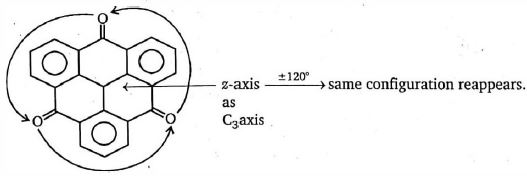
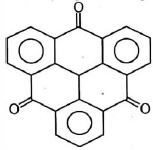
Which of the following is correct for the given compound?
  • A
     It possess centre of symmetry
     
  • B

    It possess $ C_4 $ axis of symmetry

     
  •  t possess plane of symmetry
     
  • D
     Compound is chiral
     

Answer

Correct option: C.
 t possess plane of symmetry
 
c
Molecular plane of symmetry is present in the compound. Centre of symmetry is absent because same group at the same distance does not meet.

Need a full question paper?

Generate a complete, print-ready paper with questions like this in minutes — across 16+ boards, with answer keys.
Start Generating Free

Similar questions

Which of the following elements outermost orbit's last electron has magnetic quantum number $m=0$ ?
Magnitude of Seebeck $emf$ between the junctions does not depend on:
The least electropositive alkali metal is:
The element responsible for neuromuscular function:
How many resonance forms can be written for the nitrate ion, $(NO^-_3)$ ?
In a chemical equilibrium, the rate constant of the backward reaction is $7.5 \times {10^{ - 4}}$ and the equilibrium constant is $1.5$. So the rate constant of the forward reaction is
$0.1$ $mole$ of ${N_2}{O_{4(g)}}$ was sealed in a tube under one atmospheric conditions at $25\,^oC$. Calculate the number of moles of $N{O_{2(g)}}$ present, if the equilibrium ${N_2}{O_{4(g)}}$ $\rightleftharpoons$ $2N{O_{2(g)}}$ $({K_p} = 0.14)$ is reached after some time
Increasing order of equilibrium constant for the formation of a hydrate is
A moving particle may have wave motion, if
Two reactions are given below:

$2 \mathrm{Fe}_{(\mathrm{s})}+\frac{3}{2} \mathrm{O}_{2(\mathrm{~g})} \rightarrow \mathrm{Fe}_2 \mathrm{O}_{3(\mathrm{~s})}, \Delta \mathrm{H}^{\mathrm{o}}=-822 \mathrm{~kJ} / \mathrm{mol}$

$\mathrm{C}_{(\mathrm{s})}+\frac{1}{2} \mathrm{O}_{2(\mathrm{~g})} \rightarrow \mathrm{CO}_{(\mathrm{g})}, \Delta \mathrm{H}^{\mathrm{o}}=-110 \mathrm{~kJ} / \mathrm{mol}$

Then enthalpy change for following reaction

$3\mathrm{C}_{(\mathrm{s})}+\mathrm{Fe}_2 \mathrm{O}_{3(\mathrm{~s})} \rightarrow 2 \mathrm{Fe}_{(\mathrm{s})}+3 \mathrm{CO}_{(\mathrm{g})}$