MCQ
Which of the following is correct
  • Gun metal :$Cu + Zn + Sn$
  • B
    Duralumin : $Al + Cu + Mg + Ag$
  • C
    German silver : $Cu + Zn + C$
  • D
    Solder : $Pb + Al$

Answer

Correct option: A.
Gun metal :$Cu + Zn + Sn$
a
(a)Gun metal contains $Cu (88\%), Zn (2\%), Sn(10\%), Pb (0.5\%)$ 

Need a full question paper?

Generate a complete, print-ready paper with questions like this in minutes — across 16+ boards, with answer keys.

Start Generating Free

Similar questions

The nature of charge on resulting colloidal particles when $FeCl _{3}$ is added to excess of hot water is :
$E^o _{cell}$ for the cell : 

$Pt(s) |H_2(g)\,|\,HCOOH(aq.)\,||\,CH_3COOH(aq.)\,|\,H_2(g)|Pt(s)$
at $25\,^o C$ is ............ $\mathrm{V}$

$(K_a$ of  $HCOOH \,= 2.4 × 10^{-4}$  , $K_a$ of $CH_3COOH = 1.8 × 10^{-5}$ , $log\,2\, = 0.3,\, log \,0.48, \frac{2.303 \times 298 \times R}{F} = 0.06)$

Which of the following complex is optically inactive
The conductivity of a solution of complex with formula $CoCl _{3}\left( NH _{3}\right)_{4}$ corresponds to $1: 1$ electrolyte, then the primary valency of central metal ion is
Scheme $1$ and $2$ describe the conversion of $P$ to $Q$ and $R$ to $S$, respectively. Scheme $3$ describes the synthesis of $T$ from $Q$ and $S$. The total number of $Br$ atoms in a molecule of $T$ is. . . . . . . .

Scheme $1$ : (image)

Scheme $2$ :(image)

Scheme $3$ :(image)
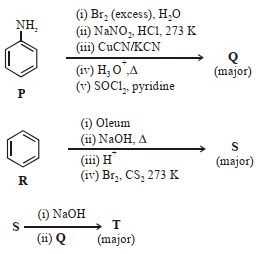
In the diazotisation of aniline with sodium nitrite and hdrochloric acid, an excess of hydrochloric acid is used primarily to:
Which of the following reaction does not give benzaldehyde as product
Which amino acid is achiral ?
$\begin{array}{*{20}{c}}
  {C{H_3} - C - C{H_2} - C - O - C{H_3}} \\ 
  \,\,{||\,\,\,\,\,\,\,\,\,\,\,\,\,\,\,\,\,\,\,\,\,\,\,\,\,\,\,\,||\,\,\,\,\,\,\,\,\,\,\,\,\,\,\,} \\ 
  {O\,\,\,\,\,\,\,\,\,\,\,\,\,\,\,\,\,\,\,\,\,\,\,\,\,\,O\,\,\,\,\,\,\,\,\,\,\,} 
\end{array}$ $\xrightarrow[{{H^ \oplus }}]{{{H_2}O}}A\xrightarrow{\Delta }B\xrightarrow{{HCN}}C$ 

what is $'B'$ and $'C'$

ortho-nitrophenol is less soluble in water than $p$-and $m$-nitrophenols because :