MCQ
Which of the following is electromagnetic wave ?
  • A
    $\alpha$-rays
  • B
    $\beta^{+}$-decay
  • C
    $\beta^{-}$-rays
  • $\gamma$-rays

Answer

Correct option: D.
$\gamma$-rays
D

Need a full question paper?

Generate a complete, print-ready paper with questions like this in minutes — across 16+ boards, with answer keys.

Start Generating Free

Similar questions

Which of the following in a hydrogen atom is independent of the principal quantum number n? (The symbols have their usual meanings).
The slope of plate characteristic of a vacuum tube diode for certain operating point on the curve is $10^{-3} \frac{\mathrm{~mA}}{\mathrm{~V}}$  The plate resistance of the diode and its nature respectively
In a transformer, the coefficient of mutual inductance between the primary and the secondary coil is 0.2 henry. When the current changes by 5 ampere/second in the primary, the induced e.m.f. in the secondary will be(a)  5 V    (b) 1 V(c)  25 V  (d) 10 V
       
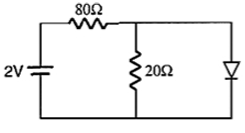
In the circuit shown, the current through the ideal diode is:
Image
A wire has a resistance of 12 ohm. It is bent in the form of equilateral triangle. The effective resistance between any two corners of the triangle is(a) 9 ohms(b) 12 ohms(c) 6 ohms(d) 8/3 ohms
       
The graph between the instantaneous concentration $(N)$ of a radioactive element and time $(t)$ is
Let $n_r$ and $n_b$ be the number of photons emitted by a red bulb and a blue bulb, respectively, of equal power in a given time$:$
Assertion  :   Self-inductance is called the inertia of electricity.
Reason      : Self-inductance is the phenomenon, according to which an opposing induced e.m.f. is produced in a coil as a result of change in current or magnetic flux linked in the coil.(a) If both assertion and reason are true and the reason is the correct explanation of the assertion.(b) If both assertion and reason are true but reason is not the correct explanation of the assertion.(c) If assertion is true but reason is false.(d) If the assertion and reason both are false.


Give the $SI$ unit of current density and its dimensional formula.
An electron moves with a constant speed $v$ along a circle of radius $r.$ Its magnetic moment will be $ (e$ is the electron's charge$)$