Question
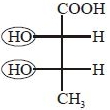
Which of the following is erythro form and optically active ?
Generate a complete, print-ready paper with questions like this in minutes — across 16+ boards, with answer keys.
$Z{n^{2 + }}\,(aq)\, + \,2e\, \rightleftharpoons \,Zn\,(s)\,;\, - \,0.762\,V$
$C{r^{3 + }}\,(aq)\, + \,3e\, \rightleftharpoons \,Cr(s)\,;\, - \,0.740\,\,V$
$2{H^ + }\,(aq)\, + \,2e\, \rightleftharpoons \,{H_2}(g)\,;\,\,\,0.00\,\,\,V$
$F{e^{3 + }}\,(aq)\, + \,e\, \rightleftharpoons \,F{e^{2 + }}(aq)\,;\,\,\,0.770\,\,\,V$
Which is the strongest reducing agent ?
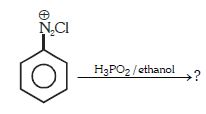
| LIST-I Name reaction | LIST-II Product obtainable | ||
| A. | Swarts reaction | I. | Ethyl benzene |
| B. | Sandmeyer's reaction | II. | Ethyl iodide |
| C. | Wurtz Fittig reaction | III. | Cyanobenzene |
| D. | Finkelstein reaction | IV. | Ethyl fluoride |
$Zn \to Z{n^{2 + }} + 2{e^ - };{E^o} = 0.76\,\,V$,$Fe \to F{e^{2 + }} + 2{e^ - };{E^o} = 0.44\,\,V$ what will be the emf of cell, whose cell-reaction is ............ $\mathrm{V}$
$F{e^{2 + }}(aq) + Zn \to Z{n^{2 + }}(aq) + Fe$
Statement $I:$ According to Bohr's model of an atom, qualitatively the magnitude of velocity of electron increases with decrease in positive charges on the nucleus as there is no strong hold on the electron by the nucleus.
Statement $II:$ According to Bohr's model of an atom, qualitatively the magnitude of velocity of electron increases with decrease in principal quantum number.
In the light of the above statements, choose the most appropriate answer from the options given below: