MCQ
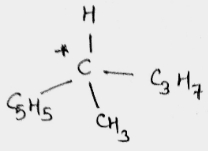
Which of the following is expected to be optically active
  • A
    ${(C{H_3})_4}C$
  • ${C_2}{H_5}CH(C{H_3}){C_3}{H_7}$
  • C
    ${({C_2}{H_5})_2}CHC{H_3}$
  • D
    $C{H_3}CH = CHC{H_3}$

Answer

Correct option: B.
${C_2}{H_5}CH(C{H_3}){C_3}{H_7}$
b
As all the four substituents attached are different. So it is chiral and hence optical active.

Need a full question paper?

Generate a complete, print-ready paper with questions like this in minutes — across 16+ boards, with answer keys.

Start Generating Free

Similar questions

The conductivity of saturated solution of $BaSO_4$ is $3.06 \times 10^{-6}\,mho\,cm^{-1}$ and its equivalent conductance is $1.5 3\,mho\,cm^2\,eq^{-1}$. Then $K_{sp}$ for $BaSO_4$ will be
A variable, opposite external potential $(E_{ext})$ is applied to the cell $Zn\,|\,Z{n^{2 + }}\,(1\,M)\,\,||\,\,C{u^{2 + }}\,(1\,M)\,|\,Cu,$ of potential $1.1\,V.$ When $E_{ext} < 1.1\,V$ and $E_{ext} > 1.1\,V,$ respectively electrons flow from
For an endothermic reaction, energy of activation is $E_a$ and enthalpy of reaction is $\Delta H$ (both of these in $kJ/mol$). Minimum value of $E_a$ will be
Two samples of lead oxide were separately reduced to metallic lead by heating in a current of hydrogen. The weight of lead from one oxide was half the weight of lead obtained from the other oxide. The data illustrates
$K_2MnO_4$ can be converted into $KMnO_4$ by
The correct order of increasing acid strenght of the compounds is

$(A)\, CH_3CO_2H$           $(B)\, MeOCH_2CO_2H$

$(C)\,CF_2CO_2H$           $(D)\,$ $Image$

The lanthanoid that does NOT show $+4$ oxidation state is
The correct match between item $I$ and item $II$ is
Item $I$ Item $II$
$(a)$ Benzaldehyde $(p)$ Mobile phase
$(b)$ Alumina $(q)$ Adsorbent
$(c)$ Acetonitrile $(r)$ Adsorbate
Which of the following complex represent maximum stability ?
Given below are two statements :
Statement(I) : Experimentally determined oxygen-oxygen bond lengths in the $O _3$ are found to be same and the bond length is greater than that of a $O = O$ (double bond) but less than that of a single ( $O - O$ ) bond.
Statement (II) : The strong lone pair-lone pair repulsion between oxygen atoms is solely responsible for the fact that the bond length in ozone is smaller than that of a double bond $( O = O )$ but more than that of a single bond $( O - O )$.
In the light of the above statements, choose the correct answer from the options given below: