MCQ
Which of the following is least basic?
  • A
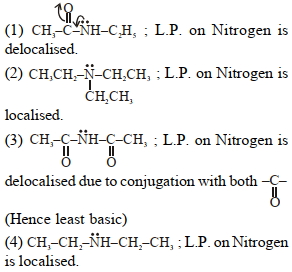
    $\left( CH _{3} CO \right) \ddot{ N } HC _{2} H _{5}$
  • B
    $\left( C _{2} H _{5}\right)_{3} \ddot{ N }$
  • $\left( CH _{3} CO \right)_{2} \ddot{ N}H$
  • D
    $\left( C _{2} H _{5}\right)_{2} \ddot{ N }H$
Answer

Correct option: C.
$\left( CH _{3} CO \right)_{2} \ddot{ N}H$
c
For the given compounds:

Need a full question paper?

Generate a complete, print-ready paper with questions like this in minutes — across 16+ boards, with answer keys.

Start Generating Free

Similar questions

Which of the following is paramagnetic?
In $Cl_2O_7$ the $\pi$ -bond between $Cl-O$ is formed by the over lapping of :-
Time required for completion of $99.9 \%$ of a First order reaction is_________ times of half life $\left(\mathrm{t}_{1 / 2}\right)$ of the reaction.
A coordination complex of type $MX_2Y_2$ ($M-$ metal ion; $X , Y-$ monodentate ligands), can have either a tetrahedral or a square planar geometry.  The maximum number of possible isomers in these two cases are respectively 
In the preparation of Grignard reagent from haloalkane, the metal
Major product ' $P$ ' formed in the following reaction is:-
Molecular formula of amyl alcohol is
$1.22\, \mathrm{~g}$ of an organic acid is separately dissolved in $100 \,\mathrm{~g}$ of benzene $\left(\mathrm{K}_{\mathrm{b}}=2.6\, \mathrm{~K}\, \mathrm{~kg} \,\mathrm{~mol}^{-1}\right)$ and $100\, \mathrm{~g}$ of acetone $\left(\mathrm{K}_{b}=1.7\, \mathrm{~K} \,\mathrm{~kg} \,\mathrm{~mol}^{-1}\right) .$ The acid is known to dimerize in benzene but remain as a monomer in acetone. The boiling point of the solution in acetone increases by $0.17^{\circ} \mathrm{C}$.

The increase in boiling point of solution in benzene in ${ }^{\circ} \mathrm{C}$ is $\mathrm{x} \times 10^{-2}$. The value of $\mathrm{x}$ is ..... .(Nearest integer)

$[$ Atomic mass : $\mathrm{C}=12.0, \mathrm{H}=1.0, \mathrm{O}=16.0]$
Which will increase the voltage of the cell $S{n_{(s)}} + 2A{g^ + }_{(aq)} \to S{n^{2 + }}_{(aq)} + 2A{g_{(s)}}$
Compound $(x)$ in the above reaction is