MCQ
Which of the following is least stable ?
  • A
    $CI_4$
  • B
    $SnI_4$
  • C
    $GeI_4$
  • $PbI_4$

Answer

Correct option: D.
$PbI_4$
d
As we go down the group the stability of halides will decrease due to increase in size of halogen atom, because of this reason the halogens easily disassociates from the compound,so lead iodide is least stable among the halides of $14^{th}$ group elements.

Non existance of $PbI _4$ can be explained on the basis of strong oxidising nature of $Pb_ 4^{+}$

$Pb ^{4+}+2 I ^{-} \rightarrow Pb ^{2+}+ I _2$

Need a full question paper?

Generate a complete, print-ready paper with questions like this in minutes — across 16+ boards, with answer keys.

Start Generating Free

Similar questions

Given 

$XNa_2HAsO_3 + YNaBrO_3 + ZHCl \longrightarrow$

$NaBr + H_3AsO_4 + NaCl$

The values of $X, Y$ and $Z$ in the above redox reaction are respectively

Select correct statement about hydrolysis of $BCl_3$ and $NCl_3$
A ball weighing $10 \,g$ is moving with a velocity of $90\, ms ^{-1}$. If the uncertainty in its velocity is $5\, \%$, then the uncertainty in its position is ....... $\times 10^{-33} \,m$. (Rounded off to the nearest integer) [Given : $\left. h =6.63 \times 10^{-34} \,Js \right]$
$CH _3- MgBr$ and $\left( C _2 H _5\right)_2 CuLi$ are _____________ .
The most common oxidation state of an element is $-2.$  The number of electrons present in its outermost shell is
Ammonia dissociates to give nitrogen and hydrogen. What happens if the pressure is increased on the system at equilibrium?
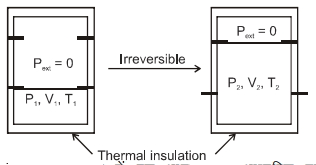
An ideal gas in a thermally insulated vessel at internal pressure $=P_1$, volume $=V_1$ and absolute temperature $= T _1$ expands irreversibly against zero external pressure, as shown in the diagram. The final internal pressure, volume and absolute temperature of the gas are $P _2, V _2$ and $T _2$, respectively. For this expansion,

$(A)$ $q=0$ $(B)$ $T_2=T_1$ $(C)$ $P_2 V_2=P_1 V_1$ $(D)$ $P_2 V_2^\gamma=P_1 V_1^\gamma$
Which of the following reaction satisfy following conditions?

$(a)$ Heat of combustion reaction

$(b)$ Heat of formation reaction

$(c)$ An exothermic reaction

$(d)$ Not neutralization reaction

Which element has neither definite shape nor volume?
Which of the following order of molecular force of attraction among given species is incorrect?