MCQ
Which of the following is not a thermodynamics co-ordinate
  • A
    $P$
  • B
    $T$
  • C
    $V$
  • $R$

Answer

Correct option: D.
$R$
(d) $R$ is the universal gas constant.

Need a full question paper?

Generate a complete, print-ready paper with questions like this in minutes — across 16+ boards, with answer keys.
Start Generating Free

Similar questions

Equation of a progressive wave is given by
$y=0.2 \cos \pi\left(0.04 t+.02 x-\frac{\pi}{6}\right)$
The distance is expressed in $\mathrm{cm}$ and time in second. What will be the minimum distance between two particles having the phase difference of $\pi / 2$
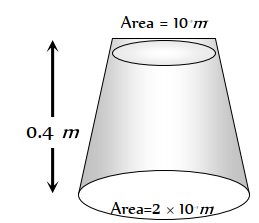
A uniformly tapering vessel is filled with a liquid of density 900 $kg / m$. The force that acts on the base of the vessel due to the liquid is $\left(g=10 ms ^{-2}\right)$
Image
If the velocity of a particle is given by $v=(180-16 x)^{1 / 2} m / s$, then its acceleration will be
The acceleration due to gravity is $g$ at a point distant $r$ from the centre of earth of radius $R$. If $r
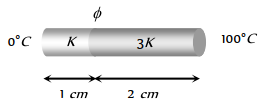
Two bars of thermal conductivities $K$ and $3 K$ and lengths $1 \mathrm{~cm}$ and $2 \mathrm{~cm}$ respectively have equal cross-sectional area, they are joined lengths wise as shown in the figure. If the temperature at the ends of this composite bar is $0^{\circ} \mathrm{C}$ and $100^{\circ} \mathrm{C}$ respectively (see figure), then the temperature $\phi$ of the interface isImage
Acceleration of a particle, executing SHM, at it's mean position is
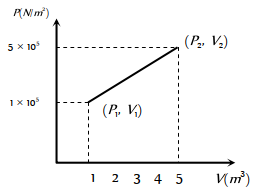
A system changes from the state $\left(P_1, V_1\right)$ to $\left(P_2 V_2\right)$ as shown in the figure. What is the work done by the system
Image
The work done against gravity in taking $10 \mathrm{~kg}$ mass at $1 \mathrm{~m}$ height in lsec will be
To convert a $800\, mV$ range milli voltmeter of resistance $40 \,\Omega$ into a galvanometer of $100\, mA$ range, the resistance to be connected as shunt is .............. $\Omega $
Two short magnets with their axes horizontal and perpendicular to the magnetic meridian are placed with their centres $40 \mathrm{~cm}$ east and $50 \mathrm{~cm}$ west of magnetic needle. If the needle remains undeflected, the ratio of their magnetic moments $M_1: M_2$ is