MCQ
Which of the following is not correct for ${N_2}O$
  • A
    It is called laughing gas
  • B
    It is nitrous oxide
  • It is not a linear molecule
  • D
    It is least reactive in all oxides of nitrogen

Answer

Correct option: C.
It is not a linear molecule
c
(c) ${N_2}{O}$ is a linear molecule

Need a full question paper?

Generate a complete, print-ready paper with questions like this in minutes — across 16+ boards, with answer keys.
Start Generating Free

Similar questions

The value of one Faraday is .............. ${\rm{C}}\,{\rm{mo}}{{\rm{l}}^{ - 1}}$
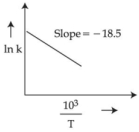
The rate constants for decomposition of acetaldehyde have been measured over the temperature range $700-1000\, K$. The data has been analysed by plotting $ln\, k\,$vs$\,\frac{10^{3}}{ T }$ graph. The value of activation energy for the reaction is $......\,kJ mol ^{-1}$. (Nearest integer) (Given : $R =8.31\, J \,K ^{-1} \,mol ^{-1}$ )
Which cation has smallest radius
The limiting molar conductivity $\mathop \Lambda \limits^o $ for $NaCl, KBr$ and $KCl$ are $126, 152$ and $150 \,S\,cm^2  \,mol^{-1}$ respectively. The $\mathop \Lambda \limits^o $ for $NaBr$ is (in $S\, cm^2\, mol^{-1}$).
The octet rule is not followed in
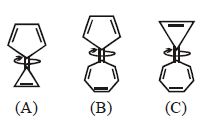
Compare carbon-carbon bond rotation energy across $A, B$ and $C$ 
For the given hypothetical reactions, the equilibrium constants are as follows: $X \rightleftharpoons Y ; K_1=1.0 , Y \rightleftharpoons Z ; K_2=2.0 , Z \rightleftharpoons W ; K_3=4.0$ The equilibrium constant for the reaction $X \rightleftharpoons W$ is
Which of the following is a redox-reaction ?
What is the potential energy of the electron in the $L-$ shell of the hydrogen atom? .............. $\mathrm{eV}$
Match the coordination number and type of hybridisation with distribution of hybrid orbitals in space based on Valence bond theory.

Coordination number and type of hybridisation Distribution of hybrid orbitals In space
$(a)$ $4, sp ^{3}$ $(i)$ trigonal bipyramidal
$(b)$ $4, dsp ^{2}$ $(ii)$ octahedral 
$(c)$ $5, sp ^{3} d$ $(iii)$ tetrahedral
$(d)$ $6, d ^{2} sp ^{3}$ $(iv)$ square planar

Select the correct option