MCQ
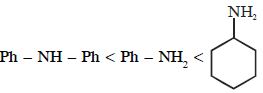
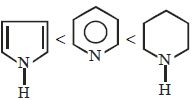
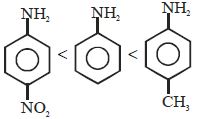
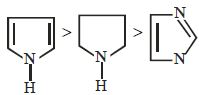
Which of the following is not correct regarding basic strength?
  • A

  • B


  • D

Answer

Correct option: C.

c
Amines are basic in nature. There basic nature is result of presence of lone pair of electrons on nitrogen. Amines when dissolved in water attract a proton to form alkylammonium ion and a hydroxide ion. The order of basicity is primary $ < $ tertiary $ > $ secondary. The aromatic amines are weaker bases than ammonia.

Need a full question paper?

Generate a complete, print-ready paper with questions like this in minutes — across 16+ boards, with answer keys.
Start Generating Free

Similar questions

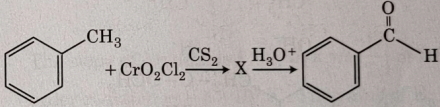
The intermediate compound $'\mathrm{X}'$ in the following chemical reaction is :
If a compound $Ab$ dissociates to the extent of $75 \,\%$ in an aqueous solution, the molality of the solution which shows a $2.5\, K$ rise in the boiling point of the solution is ......  molal.

(Rounded-off to the nearest integer) $\left[ K _{ b }=0.52 \,K \,kg\, mol ^{-1}\right]$

Which of the following is incorrectly matched?

Complex        $-$        Number of unpaired electrons
The structure of iron pentacarbonyl is:
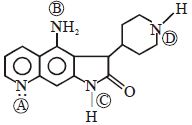
Most basic $'N'$ in following molecule is
When chlorine water is added to a solution of $KBr$, the solution immediately turns orange red, because
Chloroform when treated with aniline and alcoholic $KOH$ gives 
It has been found that for a chemical reaction with rise in temperature by $9\, K$ the rate constant gets doubled. Assuming a reaction to be occurring at $300\, K$, the value of activation energy is found to be $......\,k\,J \,mol ^{-1}$. [nearest integer]

(Given $\ln 10=2.3, R =8.3 JK ^{-1} mol ^{-1}, \log 2=0.30$ )

You have two $C_6H_{10}O$ ketones, $I$ and $II$. Both are optically active, but $I$ is racemized by treatment with acid and $II$ is not. Wolff kishner reduction of both ketones gives the same achiral hydrocarbon, formula $C_6H_{12}$. What reasonable structures may be assigned to $I$ and $II$ respectively ?
The coordination number and the oxidation state of the element $'E'$ in the complex

$[E (en)_2 (C_2O_4)]NO_2$ (where $(en)$ is ethylene diamine) are, respectively,