MCQ
Which of the following is not due to total internal reflection? 
  • A
    Working of optical fibre
  • B
    Mirage on hot summer days
  • C
    Brilliance of diamond
  • Difference between apparent and real depth of a pond 

Answer

Correct option: D.
Difference between apparent and real depth of a pond 
d
Difference between apparent and real depth of a pond is due to refraction. Other three are due to total internal reflection .

Need a full question paper?

Generate a complete, print-ready paper with questions like this in minutes — across 16+ boards, with answer keys.

Start Generating Free

Similar questions

According to Hook’s law force is proportional to
The distance of a geo-stationary satellite from the centre of the earth (Radius $R = 6400\, km$) is nearest to
Two parallel plate capacitors have their plate areas $100 \,cm ^2$ and $500 \,cm ^2$ respectively. If they have the same charge and potential and the distance between the plates of the first capacitor is $0.5 \,mm$, then the distance between the plates of the second capacitor is ........ $cm$
A $10\,\mu F$ capacitor is charged to a potential difference of $1000\, V$. The terminals of the charged capacitor are disconnected from the power supply and connected to the terminals of an uncharged $6\, \mu F$ capacitor. What is the final potential difference across each capacitor?......$V$
Acceleration due to gravity $'g'$ for a body of mass $'m'$ on earth's surface is proportional to (Radius of earth$=R$, mass of earth$=M$)
An $AM$ wave has $1800\, watt$ of total power content, For $100%$ modulation the carrier should have power content equal to......$watt$
Which does not has the same unit as others
$A$ block of mass $m$ moving with a velocity $v_0$ on a smooth horizontal surface strikes and compresses a spring of stiffness $k$ till mass comes to rest as shown in the figure. This phenomenon is observed by two observers:

$A$: standing on the horizontal surface

$B$: standing on the block 

To an observer $A,$ the net work done on the block is
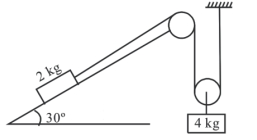
All surfaces shown in figure are assumed to be frictionless and the pulleys and the string are light. The acceleration of the block of mass $2 \mathrm{~kg}$ is :
The displacement of a particle executing SHM is given by $x=10 \sin \left(\omega t+\frac{\pi}{3}\right) \mathrm{m}$. The time period of motion is $3.14 \mathrm{~s}$. The velocity of the particle at $\mathrm{t}=0$is_________. $\mathrm{m} / \mathrm{s}$.