MCQ
Which of the following is not representative element ?
- ATellurium
- ✓Tantalum
- CThallium
- DAstatine
Metallic character decreases
Non-metallic character increases
$\Rightarrow$ It is due to increase in ionization enthalpy and increase in electron gain enthalpy.
Generate a complete, print-ready paper with questions like this in minutes — across 16+ boards, with answer keys.
$(a)$ Electron density in the $XY$ plane in $3d_x^2 - 3d_y^2$ orbital is zero
$(b)$ Electron density in the $XY$ plane in $3d_z^2$ orbital is zero
$(c)$ $2s$ orbital has one nodal surface
$(d)$ For $2pz$ orbital $YZ$ is the nodal plane.
Specify True or False.
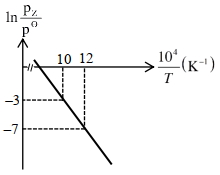
(Given, $\frac{ d (\ln K )}{ d \left(\frac{1}{T}\right)}=-\frac{\Delta H^{\ominus}}{ R }$, where the equilibrium constant, $K =\frac{ p _{ z }}{ p ^{\ominus}}$ and the gas constant, $R =8.314$ $\left.J K ^{-1} mol ^{-1}\right)$
($1$) The value of standard enthalpy, $\Delta H ^{\ominus}$ (in $kJ mol ^{-1}$ ) for the reaction is. . . . . . .
($2$) The value of $\Delta S^{\ominus}$ (in $J K ^{-1} mol ^{-1}$ ) for the given reaction, at $1000 K$ is. . . . . .
Give the answer or quetin ($1$) and ($2$)