MCQ
Which of the following is not reversible
  • Joule effect
  • B
    Peltier effect
  • C
    Seebeck effect
  • D
    Thomson effect

Answer

Correct option: A.
Joule effect
(a) Joule effect is not reversible.

Need a full question paper?

Generate a complete, print-ready paper with questions like this in minutes — across 16+ boards, with answer keys.

Start Generating Free

Similar questions

The amplitude and the time period in a S.H.M. is $0.5 cm$ and $0.4 sec$ respectively. If the initial phase is $\pi / 2$ radian, then the equation of S.H.M. will be
An ideal gas has volume $V_0$ at $27^{\circ} \mathrm{C}$. It is heated at constant pressure so that its volume becomes $2 V_0$. The final temperature is
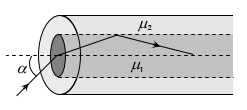
An optical fibre consists of core of $\mu$ surrounded by a cladding of $\mu$. $<\mu$. A beam of light enters from air at an angle $\alpha$ with axis of fibre. The highest $\alpha$ for which ray can be travelled through fibre isImage
The vector sum of two forces is perpendicular to their vector differences. In that case, the forces
A point object $O$ is placed on the principal axis of a convex lens of focal length $20 \mathrm{~cm}$ at a distance of $40 \mathrm{~cm}$ to the left of it. The diameter of the lens is $10 \mathrm{~cm}$. If the eye is placed $60 \mathrm{~cm}$ to the right of the lens at a distance $h$ below the principal axis, then the maximum value of $h$ to see the image will be
A 220 volt and 800 watt electric kettle and three 220 volt and 100 watt bulbs are connected in parallel. On connecting this combination with 220 volt electric supply, the total current will be
If a cylinder of diameter $1.0 \mathrm{~cm}$ at $30^{\circ} \mathrm{C}$ is to be solid into a hole of diameter $0.9997 \mathrm{~cm}$ in a steel plate at the same temperature, then minimum required rise in the temperature of the plate is :(Coefficient of linear expansion of steel $=12 \times 10^{-6} /{ }^{\circ} \mathrm{C}$ )
The acceleration of a particle performing S.H.M. is $cm sec at$ a distance of $3 cm$ from the mean position. Its time period is
On passing $96500$ coulomb of charge through a solution $CuSO _4$ the amount of copper liberated is
The work function of metal is $1 \mathrm{eV}$. Light of wavelength $3000 A$ is incident on this metal surface. The velocity of emitted photoelectrons will be