MCQ
Which of the following is not thermodynamical function
  • A
    Enthalpy
  • Work done
  • C
    Gibb's energy
  • D
    Internal energy

Answer

Correct option: B.
Work done
b
(b)Work done is not a thermodynamical function.

Need a full question paper?

Generate a complete, print-ready paper with questions like this in minutes — across 16+ boards, with answer keys.

Start Generating Free

Similar questions

The value of internal energy of an ideal gas depends on :
On investigation of light from three different stars $A, B$ and $C$ , it was found that in the spectrum of $A$ the intensity of red colour is maximum, in $B$ the intensity of blue colour is maximum and in $C$ the intensity of yellow colour is maximum. From these observations it can be concluded that
A body of mass $m_1$ moving with an unknown velocity of $v_1 \hat i$ undergoes a collinear collision with a body of mass $m_2$ moving with a velocity $v_2 \hat i$ . After collision $m_1$ and $m_2$ move with velocities of $v_3 \hat i$ and $v_4 \hat i$ respectively. If $m_2 = 0.5\, m_1$ and $v_3 = 0.5\, v_1$ then $v_1$ is:
The time period of a satellite is related to the density of earth $(\rho)$ as:
At some point the gravitational potential and also the gravitational field due to earth is zero. The point is
The diameter of a spherical bob is measured using a vernier callipers. $9$ divisions of the main scale, in the vernier callipers, are equal to $10$ divisions of vernier scale. One main scale division is $1\, {mm}$. The main scale reading is $10\, {mm}$ and $8^{\text {th }}$ division of vernier scale was found to coincide exactly with one of the main scale division. If the given vernier callipers has positive zero error of $0.04\, {cm}$, then the radius of the bob is $...... \,\times 10^{-2} \,{cm}$
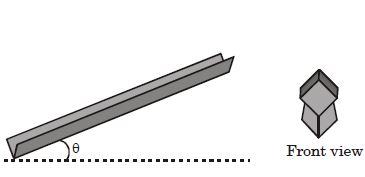
A cube of mass $m$ slides down an inclined right-angle trough. If the coefficient of kinetic friction between the cube and the trough is $\mu _k$ , then the acceleration of the block is 
The angular velocity of a body is $\mathop \omega \limits^ \to   = 2\hat i + 3\hat j + 4\hat k$ and a torque $\mathop \tau \limits^ \to   = \hat i + 2\hat j + 3\hat k$ acts on it. The rotational power will be .......... $W$
A small disc is on the top of a hemisphere of radius $R$. What is the smallest horizontal velocity v that should be given to the disc for it to leave the hemisphere and not slide down it ? [There is no friction]
A spring-mass system vibrates such that mass travel on surface of coefficient of friction  $\mu$. Mass is released after compressing the spring by distance a and it travels upto  distance $b$ after its equilibrium position, then travelling from $x = -a$ to $x = b$ the reduction in its amplitude will be :-