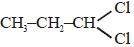
MCQ
Which of the following is optically active
  • A

  • $\begin{array}{*{20}{c}}
      {C{H_3} - CH - C{H_2}} \\ 
      {\,\,\,\,\,\,\,\,\,\,\,\,\,\,\,\,|\,\,\,\,\,\,\,\,\,\,\,\,\,\,\,\,\,\,\,|\,\,\,} \\ 
      {\,\,\,\,\,\,\,\,\,\,\,\,\,\,\,\,\,Cl\,\,\,\,\,\,\,\,\,\,\,\,\,\,\,\,\,Cl\,\,} 
    \end{array}$
  • C
    $\begin{array}{*{20}{c}}
      {\begin{array}{*{20}{c}}
      {Cl} \\ 
      | 
    \end{array}} \\ 
      {C{H_3} - C - C{H_3}} \\ 
      | \\ 
      {Cl} 
    \end{array}$
  • D
    $\begin{array}{*{20}{c}}
      {{H_2}C - C{H_2} - C{H_2}} \\ 
      {|\,\,\,\,\,\,\,\,\,\,\,\,\,\,\,\,\,\,\,\,\,\,\,\,\,\,\,\,\,\,\,|\,} \\ 
      {\,\,Cl\,\,\,\,\,\,\,\,\,\,\,\,\,\,\,\,\,\,\,\,\,\,\,\,\,\,\,Cl} 
    \end{array}$
Answer

Correct option: B.
$\begin{array}{*{20}{c}}
  {C{H_3} - CH - C{H_2}} \\ 
  {\,\,\,\,\,\,\,\,\,\,\,\,\,\,\,\,|\,\,\,\,\,\,\,\,\,\,\,\,\,\,\,\,\,\,\,|\,\,\,} \\ 
  {\,\,\,\,\,\,\,\,\,\,\,\,\,\,\,\,\,Cl\,\,\,\,\,\,\,\,\,\,\,\,\,\,\,\,\,Cl\,\,} 
\end{array}$
b

Need a full question paper?

Generate a complete, print-ready paper with questions like this in minutes — across 16+ boards, with answer keys.

Start Generating Free

Similar questions

What is the possible number of optical isomers for a compound containing $2-$dissimilar asymmetric carbon atom
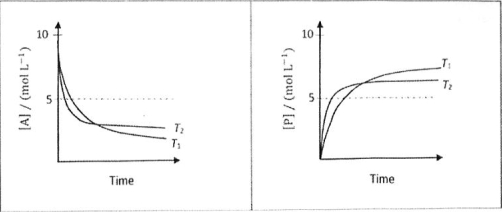
For a reaction, $A \rightleftharpoons P$, the plots of $[ A ]$ and $[ P ]$ with time at temperatures $T _1$ and $T _2$ are given below.

If $T _2> T _1$, the correct statement(s) is (are)

(Assume $\Delta H ^{\ominus}$ and $\Delta S ^{\ominus}$ are independent of temperature and ratio of $\ln K$ at $T _1$ to $\ln K$ at $T_2$ is greater than $T_2 / T_1$. Here $H, S, G$ and $K$ are enthalpy, entropy, Gibbs energy and equillibrium constant, respectively.)

$(A)$ $\Delta H ^{\ominus}<0, \Delta S ^{\ominus}<0$  $(B)$ $\Delta G ^{\ominus}<0, \Delta H ^{\ominus}>0$  $(C)$ $\Delta G ^{\ominus}<0, \Delta S ^{\ominus}<0$  $(D)$ $\Delta G ^{\ominus}<0, \Delta S ^{\ominus}>0$

Which one in the following contains ionic as well as covalent bond
In which pair second ion is more stable than first?
Which one of the following explains light both as a stream of particles and as wave motion
What is the $pH$ of a solution prepared by mixing $20\, ml$. of $0.250\, M$ sodium formate  with $30\, mL$ of $0.100\, M \,HCl\, (pK_a$ for $HCOOH = 3.75)$ :-
$\mathop {C{H_2}}\limits_{(I)}  = O \leftrightarrow \mathop {{}^ \oplus C{H_2}}\limits_{(II)}  - {O^\circleddash } \leftrightarrow \mathop {{}^\circleddash C{H_2}}\limits_{(III)}  - {O^ \oplus }$

Which of these structures is practically not a valid canonical structure for formaldehyde ?

The heat of neutralization of a strong acid and a strong alkali is $-57.0\,kJ\,mol^{-1}$ . The heat released when $0.5\,mole$ of $HNO_3$ solution is mixed with $0.2\,mole$ of $KOH$ is ....$kJ$
Toluene is nitrated and the resulting product is reduced with tin and hydrochloric acid. The product so obtained is diazotised and then heated wth cuprous bromide. The reaction mixture so formed contans
Which of the following give ${H_2}$ gas with $Na$