MCQ
Which of the following is paramagnetic
- ✓$N{i^{ + 2 }}$
- B$C{u^ + }$
- C$Z{n^{ + 2 }}$
- D$S{c^{ + 3 }}$
$_{28}Ni = [Ar]\;3{d^8}4s_2^{}$ ; $N{i^{2 + }} = [Ar]\;3{d^8}4{s^0}$
Because $N{i^{2 + }}$ have $2$ unpaired electrons in $3d$ subshell therefore it is paramagnetic.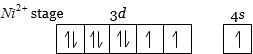
Generate a complete, print-ready paper with questions like this in minutes — across 16+ boards, with answer keys.
| $LIST-I$ | $LIST-II$ |
| $P(10 \ mL $ of $0.1 M NaOH +20 \ mL$ of $0.1 M $ acetic acid$)$ diluted to $60 \ mL$ | $1$ the value of $\left[ H ^{+}\right]$ does not change on dilution |
| $Q (20 \ mL $ of $ 0.1 \ M \ NaOH +20 \ mL $ of $0.1 \ M $ acetic acid$)$ diluted to $ 80\ mL$ | $2$ the value of $\left[ H ^{+}\right]$ changes to half of its initial value on dilution the value of $\left[ H ^{+}\right]$ changes to two times of its initial value on dilution |
| $R(20 \ mL $ of $ 0.1 \ M HCl +20 \ mL$ of $0.1 \ M$ ammonia solution$)$ diluted to $80 \ mL$ | $3$ the value of $\left[ H ^{+}\right]$changes to $1 / \sqrt{2}$ times of its initial value on dilution |
| $S10 \ mL$ saturated solution of Ni $( OH )_2$ in equilibrium with excess solid Ni $( OH )_2$ s diluted to $20 \ mL ($solid Ni $( OH )_2$ is still present afterdilution$).$ |
$4$the value of $\left[ H ^{+}\right]$changes to $\sqrt{2}$ times of its initial value on dilution |
| $5$ the value of $\left[ H ^{+}\right]$changes to $\sqrt{2}$ times of its initial value on dilution |
$' A ^{\prime} \stackrel{ HNO _3}{\longrightarrow} X ^{\prime} \stackrel{ NaBH _4}{\longrightarrow} \underset{\text { Chiral compound }}{\text { } B ^{}}$ $X$ is $.......$.