MCQ
Which of the following is paramagnetic
- ✓${O_2}$
- B$C{N^ - }$
- C$CO$
- D$N{O^ + }$
${O_2} = \sigma {(1s)^2}{\sigma ^ * }{(1s)^2}\sigma {(2s)^2}{\sigma ^ * }{(2s)^2}\sigma {(2{p_x})^2}\pi {(2{p_y})^2}$
$\pi {(2{p_z})^2}{\pi ^ * }{(2{p_y})^1}{\pi ^ * }{(2{p_z})^1}$
The molecule has two unpaired electrons So, it is paramagnetic
Generate a complete, print-ready paper with questions like this in minutes — across 16+ boards, with answer keys.
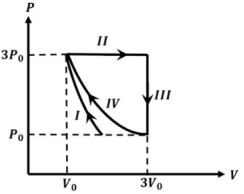
| List-$I$ | List-$II$ |
| $P$ In process $I$ | $1$ Work done by the gas is zero |
| $Q$ In process $II$ | $2$ Temperature of the gas remains unchanged |
| $R$ In process $III$ | $3$ No heat is exchanged between the gas and its surroundings |
| $S$ In process $IV$ | $4$ Work done by the gas is $6 P _0 V _0$ |
Given $\Delta H$
$(i)\, Fe_2O_{3(s)}+3C_{(graphite)} \to 2Fe_{(s)} + 3CO_{(g)}$ $492\, kJ/mol$
$(ii)\, FeO_{(s)}+C_{(graphite)} \to Fe_{(s)} + CO_{(g)}$ $156\, kJ/mol$
$(iii)\, C_{(graphite)} + O_{2(g)} \to CO_{2(g)}$ $-393 \,kJ/mol$
$(iv)\, CO_{(g)} + \frac{1}{2}\, O_{2(g)} \to CO_{2(g)}$ $-283\, kJ/mol$