MCQ
Which of the following is paramagnetic
  • A
    ${N_2}$
  • B
    ${C_2}$
  • $N_2^ + $
  • D
    $O_2^{2 - }$

Answer

Correct option: C.
$N_2^ + $
(c) ${N_2}:KK\sigma{(2s)^2}\sigma*{(2s)^2}\pi {(2{p_x})^2}\pi {(2{p_y})^2}\sigma {(2{p_z})^2}$ (diamagnetic)

${C_2}:KK\sigma{(2s)^2}\sigma*{(2s)^2}\pi {(2{p_x})^2}\pi {(2{p_y})^2}$ (diamagnetic)

$N_2^ + :KK\sigma{(2s)^2}\sigma*{(2s)^2}\pi {(2{p_x})^2}\pi {(2{p_y})^2}\sigma {(2{p_z})^2}$ (paramagnetic)

$O_2^{2 - }:KK\sigma{(2s)^2}\sigma*{(2s)^2}\sigma^* {(2{p_z})^2}\pi {(2{p_x})^2}\pi {(2{p_y})^2}$

 $\pi *{(2{p_x})^2}\pi *{(2{p_y})^2}$ (diamagnetic)

Need a full question paper?

Generate a complete, print-ready paper with questions like this in minutes — across 16+ boards, with answer keys.

Start Generating Free

Similar questions

The de Broglie wavelength associated with a ball of mass $1\, kg$ having kinetic energy $0.5\, J$ is
Most unstable resonating structure of given is
$HO - \mathop {C{H_2}}\limits_{(2)}  - \mathop {C{H_2}}\limits_{(3)}  - F$

Which conformer of above compound is most stable across $C_2 - C_3$ ?

Identify the product $D$ in the following series of reaction

$C{H_3}COOH\xrightarrow{{LiAl{H_4}}}A\mathop {\xrightarrow{{{H^ + }}}}\limits_{443\,K} B\xrightarrow{{B{r_2}}}C\mathop {\xrightarrow{{alc.}}}\limits_{KOH} D$

$\mathrm{K}_{\mathrm{n}}$ for $\mathrm{CH}_3 \mathrm{COOH}$ is $1.8 \times 10^{-3}$ and $\mathrm{K}_{\mathrm{b}}$ for $\mathrm{NH}_4 \mathrm{OH}$ is $1.8 \times 10^{-5}$. The $\mathrm{pH}$ of ammonium acetate solution will be
What measure do farmers use to control soil acidity?
When oxalic acid reacts with cone. $H_2SO_4,$ two gases produced are of neutral and acidic in nature respectively. Potassium hydroxide absorbs one of the two gases. The product formed during this absorption and the gas which gets absorbed are respectively
In the combustion of $2.0\,gm$ of methane $25\,kcal$ heat is liberated, heat of combustion of methane would be.....$kcal$
The entropy changed involved in the conversion of $ 1 $ mole of liquid water at $ 373 \,K $ to vapour at the same temperature will be $[\Delta {H_{{\rm{vap}}}} = 2.257\,kJ/gm]$
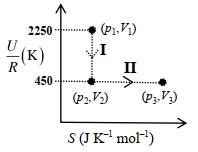
One mole of an ideal gas at $900 K$, undergoes two reversible processes, $I$ followed by $II$, as shown below. If the work done by the gas in the two processes are same, the value of $\ln \frac{V_3}{V_2}$ is. . . . . . . .  ( $U$ : internal energy, $S$ : entropy, $p$ : pressure, $V$ : volume, $R$ : gas constant) (Given: molar heat capacity at constant volume, $C_{V, m }$ of the gas is $\frac{5}{2} R$ )

( $U$ : आंतरिक ऊर्जा (internal energy), $S$ : एंट्रॉपी (entropy), $p$ : दाब (pressure), $V$ : आयतन (volume), $R$ : गैस नियतांक (gas constant)

(दिया गयाः स्थिर आयतन पर गैस की मोलर ऊष्माधारिता (molar heat capacity at constant volume), $C_{V, m }$ का मान $\frac{5}{2} R$ है)