MCQ
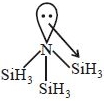
Which of the following is planar due to back bonding
  • A
    $BF_3$
  • B
    $N(CH_3)_3$
  • $N(SiH_3)_3$
  • D
    $PF_3$

Answer

Correct option: C.
$N(SiH_3)_3$
c
$\mathrm{hyb}=\mathrm{sp}^{2}$

(Trigonal planar) $=$ due to back bonding
Need a full question paper?

Generate a complete, print-ready paper with questions like this in minutes — across 16+ boards, with answer keys.

Start Generating Free

Similar questions

Tin is obtained from cassiterite by reduction with coke. Use the data given below to determine the minimum temperature (in $K$ ) at which the reduction of cassiterite by coke would take place.

At $ 298 K : \Delta_{ f } H ^{\circ}\left( SnO _2( s )\right)=-581.0 kJ mol ^{-1}, \Delta_{ fH } H ^{\circ}\left( CO _2( g )\right)=-394.0 kJ mol ^{-1}$

$S ^{\circ}\left( SnO _2( s )\right)=56.0 J K ^{-1} mol ^{-1}, S ^{\circ}( Sn ( s ))=52.0 J K ^{-1} mol ^{-1}$

$S ^{\circ}( C ( s ))=6.0 J K ^{-1} mol ^{-1}, S ^{\circ}\left( CO _2( g )\right)=210.0 J K ^{-1} mol ^{-1}$

Assume that the enthalpies and the entropies are temperature independent.

Which of the following element have highest ionization enthalpy?
Among the statements $(I - IV),$ the correct ones are:

$(I)$ $Be$ has smaller atomic radius compared to $Mg$

$(II)$ $Be$ has higher ionization enthalpy than $Al.$

$(III)$ Charge/radius ratio of $Be$ is greater than that of $Al$.

$(IV)$ Both Be and $Al$ form mainly covalent compounds.

The pressure at which liquid and vapour can coexist at equilibrium is called the:
The value of $'h\ ' = 6.63 \times 10^{-34}$ Js. The speed of light is $3 \times 10^{17}nm/ s^{-1}$. Which value is closer to the wavelength in nanometer of a quantum of light with frequency $6 \times 10^{15} s^{-1}$.
$1\,\, L$ of ${N_2}$ combines with $3\,\, L$ of ${H_2}$ to form $2\,\,L$ of $N{H_3}$ under the same conditions. This illustrates the
What is the major product of the following reaction   $C{H_3}C \equiv C - C{H_2} - C{H_3}\xrightarrow{{1\,\,{\text{mole}}\,\,{\text{of}}\,C{l_2}}}$
Powder of beryllium burns in air frequently to produce:
If little heat is added to ice $\rightleftharpoons$ liquid, equilibrium in a sealed container, then :
A hydrocarbon was found to contain $75\%$ by mass of carbon and $25\%$ by mass of hydrogen. What is empirical formula of the compound?