MCQ
Which of the following is the correct statement regarding electrochemical cell?
  • A
    It converts chemical energy to electrical energy.
  • B
    It converts electric energy to chemical energy.
  • C
    It converts chemical energy to thermal energy.
  • D
    It does not maintain the flow of charge in a circuit.

Answer

  1. It converts chemical energy to electrical energy.

Explanation:

An electrochemical cell is a device which converts chemical energy to electric energy, and maintains the flow of charge in a circuit. There are 2 types of electrochemical cells – Galvanic cell and Electrolytic cell.

Need a full question paper?

Generate a complete, print-ready paper with questions like this in minutes — across 16+ boards, with answer keys.

Start Generating Free

Similar questions

If the magnetic flux is expressed in weber, then magnetic induction can be expressed in

(a) Weber/m2

(b) Weber/m

(c) Weber-m

(d) Weber-m2

Assertion  :  from the radioactive fall out from a nuclear bomb ends up in the bones of human beings through the milk consumed by them. It causes impairment of the production of red blood cells. 

Reason      : The energetics b-particles emitted in the decay of  damage the bone marrow.

(a) If both assertion and reason are true and the reason is the correct explanation of the assertion.

(b) If both assertion and reason are true but reason is not the correct explanation of the assertion.

(c) If assertion is true but reason is false.

(d) If the assertion and reason both are false.

When an electron strikes the target in a Coolidge tube, its entire kinetic energy:

When a white light passes through a hollow prism, then

(a) There is no dispersion and no deviation

(b) Dispersion but no deviation

(c) Deviation but no dispersion

(d) There is dispersion and deviation both

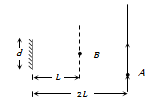
A point source of light B is placed at a distance L in front of the centre of a mirror of width d hung vertically on a wall. A man walks in front of the mirror along a line parallel to the mirror at a distance 2L from it as shown. The greatest distance over which he can see the image of the light source in the mirror is

(a) d/2

(b) d

(c) 2d

(d) 3d

The resultant of $\overrightarrow{\text{A}}$ and $\overrightarrow{\text{B}}$ makes an angle a with $\overrightarrow{\text{A}}$ and $\beta$ with $\overrightarrow{\text{B}},$

  1. $\alpha<\beta$

  2. $\alpha<\beta \text{ if}\text{ A}<\text{B}$

  3. $\alpha<\beta \text{ if}\text{ A}>\text{B}$

  4. $\alpha<\beta \text{ if}\text{ A}=\text{B}$

The unit of specific resistance is:
The diffusion current in a p-n junction is:

A transparent cube of 15 cm edge contains a small air bubble. Its apparent depth when viewed through one face is 6 cm and when viewed through the opposite face is 4 cm. Then the refractive index of the material of the cube is

(a) 2.0

(b) 2.5 

(c) 1.6

(d) 1.5

According to Joule's law, if the potential difference across a conductor having a material of specific resistance remains constant, then the heat produced in the conductor is directly proportional to

(a) ρ

(b)  

(c)  

(d)