MCQ
Which of the following is unitless quantity ?
  • A
    Velocity gradient
  • B
    Pressure gradient
  • Displacement gradient
  • D
    Force gradient

Answer

Correct option: C.
Displacement gradient
c
Gradient of a quantity $Q$ is given as $\frac{\Delta Q}{\Delta x}$

Thus, a gradient will be unitless if its numerator has same dimensions as denominator, i.e. $x$ (which has the dimension $L$ ).

Thus, out of the options, Displacement has the dimension $L$ and hence its gradient will be dimensionless.

Need a full question paper?

Generate a complete, print-ready paper with questions like this in minutes — across 16+ boards, with answer keys.

Start Generating Free

Similar questions

No work is done by a force on an object if:
Two sound waves of wavelength ${\lambda _1}$ and ${\lambda _2}$ $\left( {{\lambda _2} > {\lambda _1}} \right)$ produce $n\, beats/s$, the speed of sound is
Equation of motion in the same direction are given by

${y_1} = 2a\sin (\omega t - kx)$  and  ${y_2} = 2a\sin (\omega t - kx - \theta )$

The amplitude of the medium particle will be
A force of $750 \,N$ is applied to a block of mass $102\, kg$ to prevent it from sliding on a plane with an inclination angle $30°$ with the horizontal. If the coefficients of static friction and kinetic friction between the block and the plane are $0.4 $ and $0.3$ respectively, then the frictional force acting on the block is...... $N$
The height $y$ and the distance $x$ along the horizontal plane of a projectile on a certain planet (with no surrounding atmosphere) are given by $y = (8t - 5{t^2})$ meter and $x = 6t\, meter$, where $t$ is in second. The velocity with which the projectile is projected is ......... $m/sec$.
A body of mass $5 \,kg$ falls from a height of $30$ metre. If its all mechanical energy is changed into heat, then heat produced will be........ $cal$
Equal volumes of two gases at the same temperature and pressure have the same:
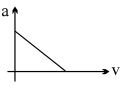
Acceleration versus velocity graph of a particle moving in a straight line starting from rest is as shown in figure. The corresponding velocity-time graph would be
Two identical solid copper spheres of radius $R$ placed in contact with each other. The gravitational attracton between them is proportional to
When $\vec A.\vec B = - |A||B|,$ then