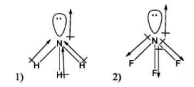
MCQ
Which of the following molecules has the maximum dipole moment ?
  • NH3
  • B
    NF3
  • C
    CO2
  • D
    CH4

Answer

Correct option: A.
NH3
(A) NH3
Image

Need a full question paper?

Generate a complete, print-ready paper with questions like this in minutes — across 16+ boards, with answer keys.

Start Generating Free

Similar questions

Identify the incorrect statement, regarding the molecule $XeO_4$ :
The decreasing basicity order of the following amines compounds is
Dipole-induced dipole interactions are present in which of the following pairs
Consider the following changes

$M(s) \to M(g)\,\,\,\,\,\,\,\,\,\,\,\,\,\, ........(1)$

$M(s) \to M^{2+} (g) + 2e^-\,\,\,\,\,\,\,\,.......(2)$

$M(g) \to M^+(g) + e^-\,\,\,\,\,\,\,\,\,\,\,.........(3)$

$M^+ (g) \to M^{2+} (g) + e^-\,\,\,\,\,\,\,\,\,.........(4)$

$M(g) \to M^{2+} (g) +2e^-\,\,\,\,\,\,\,\,\,\,\,..........(5)$

The second ionization energy of $M$ could be calculated from the energy  values assoclated with

The $EAN$ of $Fe$ in $K_4[Fe(CN)_6]$ is
In $KI$ solution, ${I_2}$ readily dissolves and forms
The correct order of $pK _{ a }$ values for the following compounds is:
The correct sequence of electron gain enthalpy of the elements listed below is

$A$. $\mathrm{Ar}$     $B$. $\mathrm{Br}$     $C. F$     $D$. $\mathrm{S}$

Choose the most appropriate from the options given below:

The number of $S-S$ bonds in $SO_3, S_2O_3^{-2}, S_2O_6^{-2}$ and $S_2O_8^{-2}$ respectively are
$\begin{matrix}
   \begin{matrix}
   C{{H}_{2}}OOCR'  \\
   |\,\,\,\,\,\,\,\,\,\,\,\,\,\,\,\,\,\,\,\,\,\,\,\,\,\,\,\,\,  \\
\end{matrix}\,\,\,  \\
   CHOOCR\,\,\,\,\,\,\,  \\
   |\,\,\,\,\,\,\,\,\,\,\,\,\,\,\,\,\,\,\,\,\,\,\,\,\,\,\,\,\,\,\,  \\
   C{{H}_{2}}OOCR'''  \\
\end{matrix}$  $\underset{\text{Hydrolysis}}{\mathop{\xrightarrow{\text{Enzyme}}}}$ $\begin{matrix}
   \begin{matrix}
   C{{H}_{2}}OH  \\
   |\,\,\,\,\,\,\,\,\,\,\,\,\,\,\,\,\,\,\,  \\
\end{matrix}  \\
   CHOH\,\,\,  \\
   |\,\,\,\,\,\,\,\,\,\,\,\,\,\,\,\,\,\,  \\
   C{{H}_{2}}OH  \\
\end{matrix}$  $+\begin{matrix}
   \begin{matrix}
   R'COOH  \\
   +  \\
\end{matrix}  \\
   R''COOH  \\
   +  \\
   R'''COOH  \\
\end{matrix}$

The enzyme used in the above reaction is