MCQ
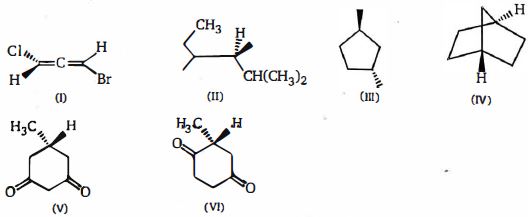
Which of the following molecules is (are) chiral ?
  • A
    $I$ and $II$
  • B
    $III$ and $IV$
  • C
    $II, IV$ and $VI$
  • $I, II, III$ and $VI$

Answer

Correct option: D.
$I, II, III$ and $VI$
d
$(d)$ Compounds do not have plane & centre of symmetry are known as optically  active compounds.

Need a full question paper?

Generate a complete, print-ready paper with questions like this in minutes — across 16+ boards, with answer keys.

Start Generating Free

Similar questions

Aluminium is more reactive than iron. But aluminium is less easily corroded than iron because
Fluorine, chlorine, bromine and iodine are placed in the same group ($17$) of the periodic table, because
Consider the species $CH _{4}, NH _{4}^{+}$and $BH _{4}^{-}$. Choose the correct option with respect to the there species .... .
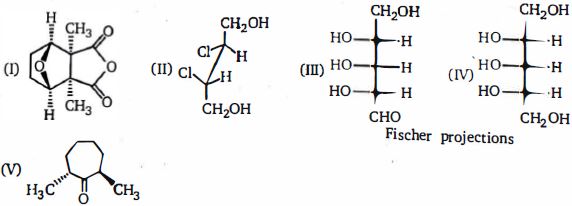
Which of the structures given' below are chiral ?
At $10\,^oC$, $1\, mol$ gas is allowed to expand reversibly and adiabatically $10\, L$ to $200\, L$. Then calculate change in entropy.....$cal/k$
According to Bronsted principle, an aqueous solution of $HN{O_3}$ will contain
The bonds between $P$ atoms and $Cl$ atoms in $PC{l_5}$ are likely to be
A gas decolourised by $KMn{O_4}$ solution but gives no precipitate with ammoniacal cuprous chloride is
Consider the following statements for $\overset{\centerdot \,\,\,\,\,\,\,\,\,\,}{\mathop{C{{H}_{3}}}}\,=X$ and $\overset{\centerdot \,\,\,\,\,\,\,\,\,\,}{\mathop{C{{F}_{3}}}}\,=Y$ .
$(I)$ When $X$ dimerises bond angle decreases
$(II)$ When $X$ dimerises bond angle increases
$(III)$ In $X-Y$ molecule $C-C$ bond length is less than that in $Y-Y$ molecule
$(IV)$ Bond angle in $X$ is greater than that in $Y$
$0.8\, \mathrm{~g}$ of an organic compound was analysed by Kjeldahl's method for the estimation of nitrogen. If the percentage of nitrogen in the compound was found to be $42\, \%$, then $....\,\mathrm{mL}$ of $1\, \mathrm{M}$ $\mathrm{H}_{2} \mathrm{SO}_{4}$ would have been neutralized by the ammonia evolved during the analysis.