MCQ
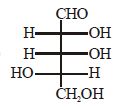
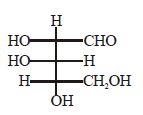
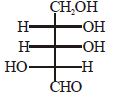
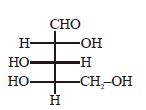
Which of the following molecules represent $D$ form :
  • A

  • B

  • C


Answer

Correct option: D.

d
$OH$ group attached to chiral $C$ atom which is at maximum distance from highest priority group. If present on $RHS \therefore  D-$configuration.

Need a full question paper?

Generate a complete, print-ready paper with questions like this in minutes — across 16+ boards, with answer keys.
Start Generating Free

Similar questions

$\mathrm{KMnO}_4$ decomposes on heating at $513 \mathrm{~K}$ to form $\mathrm{O}_2$ along with
Which of the following best describes the nucleophilic addition step in the acid- catalyzed hydrolysis of acetonitrile $(CH_3CN)$ ?
H2S is a toxic gas used in qualitative analysis. If solubility of H2S in water at STP is 0.195m. what is the value of KH?
The major product of the following reaction is
The complex ion which has no $'d'$ electrons in the central metal atom is :
On passing electric current through molten aluminium chloride, $ 11.2$  litre of $C{l_2}$ is liberated at $NTP$  at anode. The quantity of aluminium deposited at cathode is .............. $\mathrm{g}$ (at. wt. of $Al = 27$)
The compound formed on heating chlorobenzene with chloral in the presence of concentrated sulphuric acid, is
The bromination of acetone that occurs in acid solution is represented by this equation.

$CH_3COCH_{3(aq)} + Br_{2(aq)} \rightarrow $$CH_3COCH_2Br_{(aq)} + H^+_{(aq)}+ Br^-_{(aq)}$

These kinetic data were obtained for given reaction concentrations.

 Initial concentrations, $M$

$[CH_3COCH_3]$ $[Br_2]$ $[H^+]$
$0.30$ $0.05$ $0.05$
$0.30$ $0.10$ $0.05$
$0.30$ $0.10$ $0.10$
$0.40$ $0.05$ $0.20$

Initial rate, disappearance of $Br_2, \,\,Ms^{-1}$

$5.7 \times 10^{-5} ,$  $5.7 \times 10^{-5} ,$  $1.2 \times 10^{-5} ,$  $3.1 \times 10^{-5}$

Based on these data, the rate equation is

Complete the following reaction : $R\,\,N{H_2} + {H_2}S{O_4} \to $
What are the organic products formed in the following reaction

${C_6}{H_5} - COO - C{H_3}\mathop {\xrightarrow{{1.\,LiAl{H_4}}}}\limits_{2.\,{H_2}O} $