MCQ
Which of the following monomers form biodegradable polymers?
$a. 3-$hydroxybutanoic acid $+ 3-$hydroxypentanoic acid.
$b.$ Glycine $+$ amino caproic acid.
$c.$ Ethylene glycol $+$ phthalic acid.
$d.$ Caprolactum.
  • $a$ and $b$
  • B
    $a$ and $c$
  • C
    $b$ and $c$
  • D
    $b$ and $d$

Answer

Correct option: A.
$a$ and $b$
Poly$-\beta-$hydroxybutyrate $co-\beta-$hydroxy valerate $\text{(PHBV)}$ It is obtained by the copolymerisation of $3$ hydroxybutanoic acid and $3-$hydroxypentanoic acid$. \text{PHBV}$ is used in speciality packaging orthopaedic devices and in controlled release of drugs$. \text{PHBV}$ undergoes bacterial degradation in the environment.
Nylon$-2-$nylon $6:$ It is an alternating polyamide copolymer of glycine $\left(\mathrm{H}_2 \mathrm{N}-\mathrm{CH}_2-\mathrm{COOH}\right)$ and amino caproic acid $\left[\mathrm{H}_2 \mathrm{N}\left(\mathrm{CH}_2\right)_5 \mathrm{COOH}\right]$ and is biodegradable.

Need a full question paper?

Generate a complete, print-ready paper with questions like this in minutes — across 16+ boards, with answer keys.

Start Generating Free

Similar questions

The electronic spectrum of $\left[ Ti \left( H _{2} O \right)_{6}\right]^{3+}$ shows a single broad peak with a maximum at $20,300\, cm ^{-1} .$ The crystal field stabilization energy $(CFSE)$ of the complex ion, in $kJ\, mol ^{-1}$, is :
Which complex shows highest crystal field stabilisation energy
From the following which is a second order reaction
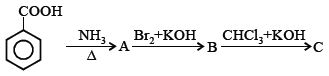
Product $C$ is
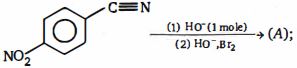
Product $(A)$ is
Which of the following are anionic detergents?
$a.$ Sodium salts of sulphonated long chain alcohol.
$b.$ Ester of stearic acid and polyethylene glycol.
$c.$ Quarternary ammonium salt of amine with acetate ion.
$d.$ Sodium salts of sulphonated long chain hydrocarbons.
Which of the following is correct order of ligand field strength?
$\begin{array}{*{20}{c}}
  {\begin{array}{*{20}{c}}
  {CH = O\,\,\,\,\,\,\,\,\,\,} \\ 
  {|\,\,\,\,\,\,\,\,\,\,\,\,\,\,\,\,\,\,\,\,\,\,\,\,\,} 
\end{array}} \\ 
  {{{(CH - OH)}_4}} \\ 
  {\,\,\,|\,\,\,\,\,\,\,\,\,\,\,\,\,\,\,\,\,\,\,\,\,\,\,\,\,\,} \\ 
  {C{H_2} - OH} 
\end{array}$ $\xrightarrow{{B{r_2}/{H_2}O}}P$ ; $P$ is
The following data was obtained for chemical reaction given below at $975\, \mathrm{~K}$.

$2 \mathrm{NO}_{(\mathrm{g})}+2 \mathrm{H}_{2(\mathrm{~g})} \rightarrow \mathrm{N}_{2(\mathrm{~g})}+2 \mathrm{H}_{2} \mathrm{O}_{(\mathrm{g})}$


$[NO]$

$\mathrm{mol} \mathrm{L}^{-1}$

${H}_{2}$

$\mathrm{mol} \mathrm{L}^{-1}$

Rate 

$\mathrm{mol}L^{-1}$ $s^{-1}$

$(A)$ $8 \times 10^{-5}$ $8 \times 10^{-5}$ $7 \times 10^{-9}$
$(B)$ $24 \times 10^{-5}$ $8 \times 10^{-5}$ $2.1 \times 10^{-8}$
$(C)$ $24 \times 10^{-5}$ $32 \times 10^{-5}$ $8.4 \times 10^{-8}$

The order of the reaction with respect to $\mathrm{NO}$ is ..... .

Wilkinson catalyst is