MCQ
Which of the following numbers has non $-$ terminating repeating decimal expansion ?
  • A
    $\frac{35}{50}$
  • B
    $\frac{15}{1600}$
  • $\frac{17}{6}$
  • D
    $\frac{23}{2}$

Answer

Correct option: C.
$\frac{17}{6}$
$\frac{17}{6}$ has a non $-$ terminal repeating decimal expansion.
$\frac{17}{6}=2.6333 ...$

Need a full question paper?

Generate a complete, print-ready paper with questions like this in minutes — across 16+ boards, with answer keys.
Start Generating Free

Similar questions

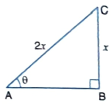
If $\operatorname{cosec} \theta=2$ and $\cot \theta=\sqrt{3} a$, then the value of $a$ is
Image
Which of the following measures of central tendency is influenced by extreme values?
The radius of a circle whose circumference is equal to the sum of the circumferences of two circles of diameters $36\ cm$ and $20\ cm$ is:
If $R (5,6)$ is the midpoint of the line segment AB joining the points $A (6,5)$ and $B (4, y )$ then y equals
Choose the correct answer from the given four options.
To draw a pair of tangents to a circle which are inclined to each other at an angle of 60°, it is required to draw tangents at end points of those two radii of the circle, the angle between them should be:
Directions : In the following questions, the Assertions $(A)$ and Reason $(s)\ (R)$ have been put forward. Read both the statements carefully and choose the correct alternative from the following:
Assertion : Sum of first hundred even natural numbers divisible by $5$ is $500.$
Reason : Sum of first $n-$ terms of an $A.P$. is given by $\text{s}_\text{n}=\frac{\text{n}}{2}[\text{a+}\ell] \text{ where }\ell =$ last term.
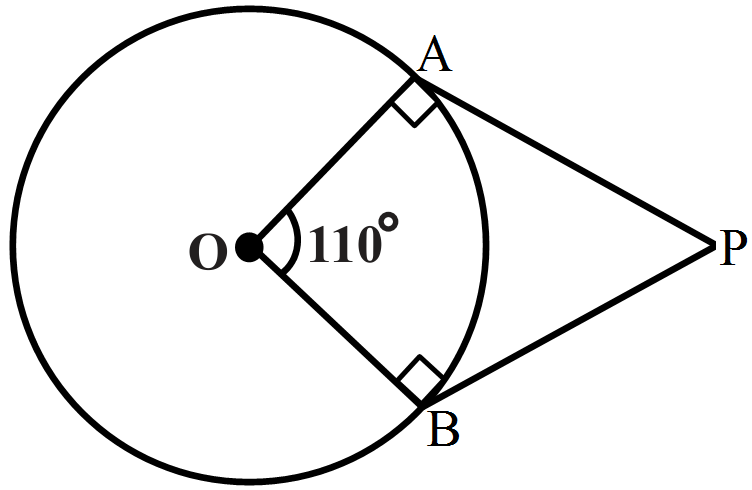
If PA and PB are two tangents to a circle with centre O, such that $\angle\text{AOB} = 110^\circ,$ find $ \angle\text{APB}$ is equal to
If zeroes of the quadratic polynomial $a x^2+b x+c, c \neq 0$ are equal, then
The point of intersection of the lines represented by $3 x-2 y=6$ and the $x$-axis is
The value of $\Big(\sin^230^\circ\cos^245^\circ+4\tan^230^\circ+\frac{1}{2}\sin^290^\circ+\frac{1}{8}\cot^260^\circ\Big)=?$