MCQ
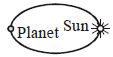
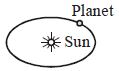
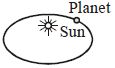
Which of the following orbits is a possible orbit for a planet ?
  • A

  • B

  • C


Answer

Correct option: D.

d
Sun must be at one focus, which location is inside away from centre and symmetric option $(4).$

Need a full question paper?

Generate a complete, print-ready paper with questions like this in minutes — across 16+ boards, with answer keys.
Start Generating Free

Similar questions

The internal energy of an ideal gas depends upon
Two equations of two $S.H.M.$ are $y = a\sin \,(\omega \,t - \alpha )$ and $y = b\cos (\omega \,t - \alpha )$. The phase difference between the two is .... $^o$
A source and an observer approach each other with same velocity $50 m/s$. If the apparent frequency is $435 \,s^{-1}$, then the real frequency is .... $s^{-1}$
A big ball of mass $M$, moving with velocity $u$ strikes a small ball of mass $m$, which is at rest. Finally small ball obtains velocity $u$ and big ball $v$. Then what is the value of $v$
Suppose a tunnel is dug along a diameter of the earth. A particle is dropped from a point, a distance h directly above the tunnel. The motion of the particle as seen from the earth is:
  1. Simple harmonic.
  2. Parabolic.
  3. On a straight line.
  4. Periodic.
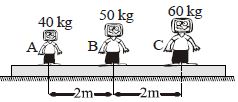
Three men $A, B$ and $C$ of masses $40\,\,kg, 50\,\,kg$ and $60\,\,kg$  are standing on a plank of mass $90\,\,kg,$  which is kept on a smooth horizontal plane. If $A$ and $C$ exchange their positions then mass $B$   will shift
The relation between $\gamma ,\,\eta $ and $K$ for a elastic material is
The equation of state of $n$ moles of a non-ideal gas can be approximated by the equation $\left(p+\frac{n^2 \alpha }{V^2}\right)(V-n b)=n R T$ where $a$ and $b$ are constant characteristics of the gas. Which of the following can represent the equation of a quasistatic adiabat for this gas (assume that, $C_V$ is the molar heat capacity at constant volume is independent of temperature)?
Two cars $A$ and $B$ are travelling in the same direction with velocities ${v_1}$ and ${v_2}$$({v_1} > {v_2})$. When the car $A$ is at a distance $d$ ahead of the car $B$, the driver of the car $A$ applied the brake producing a uniform retardation $a$ There will be no collision when
Two particles P and Q describe S.H.M. of same amplitude $a$, same frequency $f$ along the same straight line. The maximum distance between the two particles is a $\sqrt{2}$.The initial phase difference between the particle is -