MCQ
Which of the following order is correct ?
- A$Si-Si > C-C > Ge-Ge$ (Bond energy)
- B$H-H > F-F > C-C$ (Bond energy)
- C$Ge < Sn < Pb$ (ability of $ns^2e^-$ to participate in bonding)
- ✓$SiH_4 > SnH_4 > PbH_4 > CH_4$ (easy of hydrolysis)
Generate a complete, print-ready paper with questions like this in minutes — across 16+ boards, with answer keys.

$\mathrm{A}(\mathrm{g}) \rightarrow 2 \mathrm{~B}(\mathrm{~g})+\mathrm{C}(\mathrm{g})$
If the total pressure of the gases is found to be $200$ torr after $23 \mathrm{sec}$. and $300$ torr upon the complete decomposition of $\mathrm{A}$ after a very long time, then the rate constant of the given reaction is . . . . . .$\times 10^{-2} \mathrm{~s}^{-1}$ (nearest integer)
[Given : $\log _{10}(2)=0.301$ ]
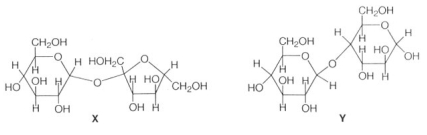
$(A)$ ${X}$ is a reducing sugar and ${Y}$ is a non-reducing sugar
$(B)$ ${X}$ is a non-reducing sugar and ${Y}$ is a reducing sugar
$(C)$ The glucosidic linkages in ${X}$ and ${Y}$ are $\alpha$ and $\beta$, respectively
$(D)$ The glucosidic linkages in ${X}$ and ${Y}$ are $\beta$ and $\alpha$, respectively