MCQ
Which of the following order is incorrect ?
- ✓Ionic character $\to MCl < MCl_2 < MCl_3$
- BPolarizibility $\to F^-< Cl^-< Br^-< I^-$
- CPolarising power $\to Na^+ < Ca^{+2} < Mg^{+2} < Al^{+3}$
- DCovalent character $\to LiF < LiCl < LiBr < Lil$
Generate a complete, print-ready paper with questions like this in minutes — across 16+ boards, with answer keys.
(Given atomic number: $\mathrm{Sc}: 21, \mathrm{Ti}: 22, \mathrm{~V}: 23$, $\mathrm{Cr}: 24, \mathrm{Mn}: 25, \mathrm{Fe}: 26, \mathrm{Co}: 27, \mathrm{Ni}: 28, \mathrm{Cu}: 29$, $\mathrm{Zn}: 30)$
$2 \mathrm{~A}_{(\mathrm{g})}+\mathrm{B}_{(\mathrm{g})} \rightarrow \mathrm{C}_{(\mathrm{g})}$
The initial rate of the reaction is recorded as $r_1$ when the reaction starts with $1.5 \mathrm{~atm}$ pressure of $\mathrm{A}$ and $0.7 \mathrm{~atm}$ pressure of B. After some time, the rate $r_2$ is recorded when the pressure of $C$ becomes $0.5 \mathrm{~atm}$. The ratio $r_1: r_2$ is $\qquad$ $\times 10^{-1}$.
(Nearest integer)
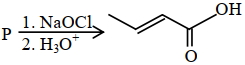
Choose the correct answer from the options given below