MCQ
Which of the following pairs has same structure
  • A
    $P{H_3}$ and $BC{l_3}$
  • B
    $S{O_2}$ and $N{H_3}$
  • C
    $PC{l_5}$ and $S{F_6}$
  • $NH_4^ + $ and $SO_4^{2 - }$

Answer

Correct option: D.
$NH_4^ + $ and $SO_4^{2 - }$
(d)$NH_4^ + $ and $SO_4^{2 - }$ both show $s{p^3}$-hybridization and tetrahedral structure.

Need a full question paper?

Generate a complete, print-ready paper with questions like this in minutes — across 16+ boards, with answer keys.

Start Generating Free

Similar questions

How many $\sigma $ and $\pi $ bonds are there in the molecule of tetracyanoethylene

 $\begin{array}{*{20}{c}} {N \equiv C} \\  {N \equiv C}\end{array}\,\,\left. {} \right\rangle C = C\,\left\langle {} \right.\,\begin{array}{*{20}{c}} {C \equiv N} \\ {C \equiv N} \end{array}$

According to Le-Chatelier’s principal adding heat to a solid and liquid in equilibrium with endothermic nature will cause the
Hydrolysis of which of the following does not occur
A photon-sensitive metal is not emitting photoelectron when irradiated. It will do so when threshold is crossed. To cross the threshold we need to increase:
Mendeleef's periodic law is based on
Which of the following pairs of compound are not isomers ?
The rates of a certain reaction $(dc/dt)$ at different times are as follows

Time                                 Rate (mole $litre^{-1}\,sec^{ -1}$ )

$0$                                        $2.8 \times {10^{ - 2}}$

$10$                                      $2.78 \times {10^{ - 2}}$

$20 $                                     $2.81 \times {10^{ - 2}}$

$30$                                       $2.79 \times {10^{ - 2}}$

The reaction is
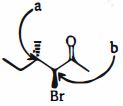
Determine the absolute configurations of the chiral centres in the following compound
Standard electrode potential of three metals $X , Y$ and $Z$ are $-1.2 \,V, + 0.5\, V$ and $- 3.0\, V$ respectively. The reducing power of these metals will be
Addition of $HI$ on the double bond of propene yields isopropyl iodide and not $ n-$ propyl iodide as the major product. This is because the addition proceeds through