MCQ
Which of the following process can not give $Cl_2$ gas
  • A
    Electrolysis of aqeous $NaCl$
  • B
    Oxidation of conc. $HCl$ by $KMnO_4$
  • C
    Oxidation of conc. $HCl$ by $MnO_2$
  • By the reaction of $NaCl$ and conc. $H_2SO_4$

Answer

Correct option: D.
By the reaction of $NaCl$ and conc. $H_2SO_4$
d
$(a)$  $-$ Bond dissociation energy of $\mathrm{F}_{2}$ is less than that of $\mathrm{Cl}_{2}$

$(b)$  $-$  $Cl$ has higher $E.A.$ than fluorine

$(c)$  $-$  $HF$ is weaker acid than $\mathrm{HCl}$, due to higher bond energy

Need a full question paper?

Generate a complete, print-ready paper with questions like this in minutes — across 16+ boards, with answer keys.

Start Generating Free

Similar questions

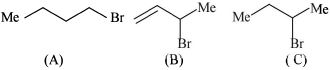
Consider the following bromides :.

The correct order of ${S_{{N^1}}}$ reactivity is
How many geometrical isomers and stereoisomers are possible for 
$[Pt(NO_2)(NH_3)(NH_2OH)(Py)^+$ and $[Pt(Br)(Cl)(I)(NO_2)(NH_3)(Py)]$ respectively?
Raoult's law is obeyed by each constituent of a binary liquid solution when
A gas at low temperature does not react with the most of compounds. It is almost inert and is used to create inert atmosphere in bulbs. The combustion of this gas is exceptionally an endothermic reaction. Based on the given information, we can conclude that the gas is
Which of the following is suitable to synthesize chlorobenzene?
The mixture that forms maximum boiling azeotrope is
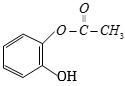
The following compound is used as
Given below are two statements : one is labelled as Assertion $(A)$ and the other is labelled as Reason $(R)$.

Assertion $(A)$ : Experimental reaction of $CH _{3} Cl$ with aniline and anhydrous $AlCl _{3}$ does not give $o$ and $p-methylaniline$.

Reason $(R)$ : The - $NH _{2}$ group of aniline becomes deactivating because of salt formation with anhydrous $AlCl _{3}$ and hence yields $m$-methyl aniline as the product.

In the light of the above statements, choose the most appropriate answer from the options given below.
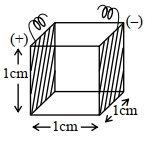
A conductivity cell with two electrodes (dark side) are half filled with infinitely dilute aqueous solution of a weak electrolyte. If volume is doubled by adding more water at constant temperature, the molar conductivity of the cell will -
Butanal with dilute $NaOH$ gives