MCQ
Which of the following processes is reversible
  • A
    Transfer of heat by radiation
  • B
    Electrical heating of a nichrome wire
  • C
    Transfer of heat by conduction
  • Isothermal compression

Answer

Correct option: D.
Isothermal compression
d
(d) Slow isothermal expansion or compression of an ideal gas is reversible process, while the other given process are irreversible in nature.
 

Need a full question paper?

Generate a complete, print-ready paper with questions like this in minutes — across 16+ boards, with answer keys.
Start Generating Free

Similar questions

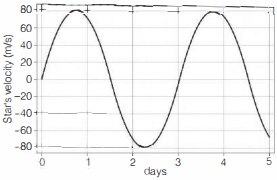
A star of mass $M$ (equal to the solar mass) with a planet (much smaller than the star) revolves around the star in a circular orbit. The velocity of the star with respect to the centre of mass of the star-planet system is shown below. The radius of the planet's orbit is closest to .......... $AU$ $(1 \,AU =$ Earth-Sun distance)
The length of a metallic rod is $5m$ at $0°C$ and becomes $  5.01\, m$, on heating upto $100°C$. The linear expansion of the metal will be
A particle executes linear simple harmonic motion with an amplitude of $2\, cm$. When the particle is at $1\, cm$ from the mean position the magnitude of its velocity is equal to that of its acceleration. Then its time period in seconds is
When a tuning fork of frequency $341$ is sounded with another tuning fork, six beats per second are heard. When the second tuning fork is loaded with wax and sounded with the first tuning fork, the number of beats is two per second. The natural frequency of the second tuning fork is
If pressure $P$, velocity $V$ and time $T$ are taken as fundamental physical quantities, the dimensional formula of force is
The unit of permittivity of free space is
If a Vander-Waal's gas expands freely, then final temperature is
To determine the Young's modulus of a wire, the formula is $Y = \frac{FL}{A\Delta L};$ where $L$ = length, $A = $area of cross-section of the wire, $\Delta L = $change in length of the wire when stretched with a force $F$. The conversion factor to change it from $CGS$ to $MKS$ system is .............. $10^{-1}\mathrm{N/m}^{2}$
Two particles $P_1$ and $P_2$ are moving with velocities $v_1$ and $v_2$ respectively. Which of the statement about their relative velocity $v_{12}$ is true?
A block of mass ${m_1}$ rests on a horizontal table. A string tied to the block is passed on a frictionless pulley fixed at the end of the table and to the other end of string is hung another block of mass ${m_2}$. The acceleration of the system is