Question
Which of the following properties show that light is a transverse wave?
  1. Reflection.
  2. Interference.
  3. Diffraction.
  4. Polarization.

Answer

  1. Polarization.
Explanation:
Reflection, interference and diffraction are the phenomena shown by both transverse waves and longitudinal waves. Polarization is the phenomenon shown only by transverse waves.

Need a full question paper?

Generate a complete, print-ready paper with questions like this in minutes — across 16+ boards, with answer keys.
Start Generating Free

Similar questions

The probability of electrons to be found in the conduction band of an intrinsic semiconductor at a finite temperature(a) Decreases exponentially with increasing band gap(b) Increases exponentially with increasing band gap(c) Decreases with increasing temperature (d) Is independent of the temperature and the band gap


Total internal reflection of a ray of light is possible when the $(i_c =$ critical angle, $i  =$  angle of incidence$)$
Among the particles moving with the same velocity, the de Broglle wavelength will be maximum of :
There are two charges +1 microcoulombs and +5 microcoulombs. The ratio of the forces acting on them will be(a) 1 : 5(b) 1 : 1(c) 5 : 1(d) 1 : 25
       
A certain amount of current when flowing in a properly set tangent galvanometer, produces a deflection of $45^{\circ}$. If the current be reduced by a factor of $\sqrt{3}$ , the deflection would
Electromagentic waves were produced in laboratory first by:
If in a voltaic cell $5 \ gm$ of zinc is consumed, then we get how many ampere hours? $($Given that $\text{E.C.E.}$ of $Zn$ is $3.387 \times 10^{-7} \mathrm{~kg} / \text { coulomb }$
 
The quantisation of charge indicates that:
One end of a light spring of spring constant k is fixed to a wall and the other end is tied to a block placed on a smooth horizontal surface. In a displacement, the work done by the spring is $\frac{1}{2}\text{kx}^2.$ The possible cases are:
  1. At spring was initially compressed by a distance x and was finally in its natural length.
  2. It was initially stretched by a distance x and and finally was in its natural length.
  3. It was initially in its natural length and finally in a compressed position.
  4. It was initially in its natural length and finally in a stretched position.
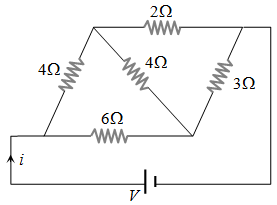
For the network shown in the figure the value of the current $i$ is