Answer

Correct option: D.
Gibbs free energy
(D) Gibbs free energy
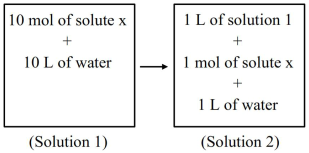
Both solutions are having same composition, which is 1 mole of ' $x$ ' in 1 ' $\ell$ ' water, so all the intensive properties will remain same, but as total amount is greater in solution ' 1 ' compared to solution ' 2 '. So extensive properties will be different hence Gibbs free energy will be different.

Need a full question paper?

Generate a complete, print-ready paper with questions like this in minutes — across 16+ boards, with answer keys.
Start Generating Free

Similar questions

A gas occupies $1.5$ litre at $S.T.P.$ It is provided with $300$ joule of heat so that its volume becomes $2$ litre at a pressure of $1\,atm.$ The value of $\Delta U$ for the
process is.....$joule$
Latent heat of vaporisation of a liquid at $500\, K$ and $1 \,atm$ pressure is $20.0\, kcal/mol$. What will be the change in internal energy $(\Delta E)$ of $3\, mol$ of liquid at  same temperature......$Kcal$
Silver is removed electrically from $200\,ml$ of a $0.1\,N$  solution of $AgN{O_3}$ by a current of $ 0.1$  ampere. How long will it take to remove half of the silver from the solution .............. $\mathrm{sec}$
Which of the following $2-$ halo nitrobenzene is most reactive towards  nucleophilic aromatic substitution ?
Which of following can be use to convert $3-$ methyl butan $-2-$ one in to isopentane
Given below are two statements :
Statement I : D-glucose pentaacetate reacts with 2, 4-dinitrophenylhydrazine.
Statement II : Starch, on heating with concentrated sulfuric acid at $100^{\circ} \mathrm{C}$ and $2-3$ atmosphere pressure produces glucose.
In the light of the above statements, choose the correct answer from the options given below
The $IUPAC$ name of the following compound is
The correct statements about compounds $A, B$ and $C$ is/are
In a constant pressure process for $5$ mole of an ideal monoatomic gas, the temperature of gas increased from $300\ K$ to $500\ K$ . Which of the following is incorrect regarding the process?
In the above reaction, product $(B)$ is: